
NEWS
State Wildfire Preparedness Level at Level 4 due to increased activity

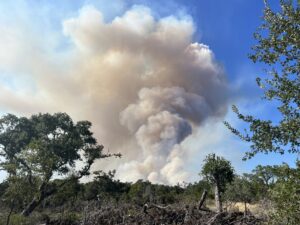
The Texas A&M Forest Service has raised the State Wildfire Preparedness Level to Level 4 due to the recent increase in wildfire activity statewide and growing potential for wildfires to become more severe and harder to control.
An increasing number of wildfires across Texas has prompted the Texas A&M Forest Service to raise the State Wildfire Preparedness Level to a Level 4. (Texas A&M Forest Service photo)
“The decision to move to a Preparedness Level 4 indicates that the complexity of wildfires across Texas is increasing to where they require more time, personnel and equipment to contain and put out,” said Wes Moorehead, Texas A&M Forest Service fire chief.
This week, very high to extreme fire danger is forecast for broad regions of the state, including areas along the Interstate 35 corridor between Dallas, Waco, Austin and San Antonio, and extending west to Abilene and Wichita Falls.
Regions with increased risk also include areas east of Interstate 45 and south of Interstate 20, near Jacksonville, Center, Lufkin, Crockett, Huntsville, Woodville, Cleveland, Kirbyville and Jasper.
Critical fire weather, characterized by increased wind speeds and triple-digit temperatures, will align with very dry vegetation to produce an environment with high potential for wildfires that are resistant to firefighters’ suppression efforts and may impact citizens within the identified areas of concern.
Recent wildfire efforts
Over the past week, state and local firefighters have responded to 119 wildfires that burned 9,012 acres.
“I continue to be impressed by the dedication and selfless service of firefighters across the state,” Moorehead said. “Every single day, they work in some of the hottest and most challenging conditions. These responders do a tremendous job protecting lives and property from destructive wildfires.
“It is crucial that everyone in Texas take care to prevent wildfires and be cautious of any outdoor activity that may cause a spark. If a wildfire is spotted, immediately contact local authorities. A quick response can help save lives and property.”

The Nocona City Council will meet in a called session at 8 a.m. on Sept. 30 at city hall.
An executive session is on the agenda listed as consultation with the city attorney for personnel matters regarding an officer or employee. Any action would be taken back in open session.
In regular agenda items, the council will consider closing the 100 block of East Oak for a street dance during Art of the Song, plus temporary closure of streets for the homecoming parade and pep rally.
A resolution approving Ben Van Wingerden making enhancements to the downtown city park through landscaping, lighting, seating and an enclosed gazebo at no cost to the city will be reviewed.

Members of the Montague County Commissioner’s Court will meet at 9 a.m. on Sept. 28 in the courthouse annex.
The agenda opens with a report from members of the Montague Texas Extension Education Association on their activities this pat year. Jaxon Phipps also will be considered for appointment to the child welfare board.
An executive session is set for personnel matters related to the county jail. Any action would be back in open session.
Several budgetary items are on the agenda including a shortfall in the jail budget of $16,403.04 and a shortfall in the emergency management budget of $3,379.85. Line item budget adjustment for fiscal 2026 will be considered as the year comes to a close. The precinct four budget also will see an adjustment from machinery and equipment to personnel.
Other topics on Monday’s agenda will include: Order setting the term of the commissioner’s court; approval of the county clerk’s records’ management and records archive written plan for 2026-27 and notice of joint/general election for Nov. 3, along with agreements with the Cities of Bowie and Saint Jo and school districts in Forestburg and Gold-Burg to conduct their elections.
Five agreements will be offered: Interlocal participation agreement between the county and Texas Association of Counties CIRA program; licensing addendum between Kologik and the sheriff’s office, approve Federal Bureau of Investigation Criminal Justice Information Services Security addendum between Kologik and the sheriff’s office; interlocal agreement between the Clay County Sheriff’s office and the county sheriff for the Texas Law Enforcement Telecommunications System Access; and management control agreement between the sheriff’s office and Jessica Moster regarding the Texas Department of Public Safety and FBI Criminal Justice Information Systems.

The deadline to register in time to vote in the Nov. 3 elections is Oct. 5 and all applications must be received in the election’s office no later than 5 p.m. that day.
A voter can go online to the Texas Secretary of State’s office to check on your registration to make sure it is valid and up to day. To register complete an online voter registration application that is on the SOS webpage or the county elections page at co.montague.tx.us. After your fill in the required information, print, sign and mail or hand deliver it to the county election’s office in the courthouse annex at Montague.
Changes to your voter registration such as a new address can be done online.
Read the full story in your Thursday Bowie News.






-

 NEWS3 years ago
Suspect indicted, jailed in Tia Hutson murder
-
 NEWS4 years ago
2 hurt, 1 jailed after shooting incident north of Nocona
-

 NEWS4 years ago
Wreck takes the life of BHS teen, 16
-
 NEWS3 years ago
SO investigating possible murder/suicide
-

 NEWS3 years ago
Murder unsolved – 1 year later Tia Hutson’s family angry, frustrated with no arrest
-
 Show us something good9 years ago
Country music star children perform in Bowie
-
 100th Birthday4 years ago
Looking back at the 1958 Centennial edition of The Bowie News
-
NEWS3 years ago
Sheriff’s office called out to infant’s death