
SPORTS
Cantwell continuing to flourish at next level

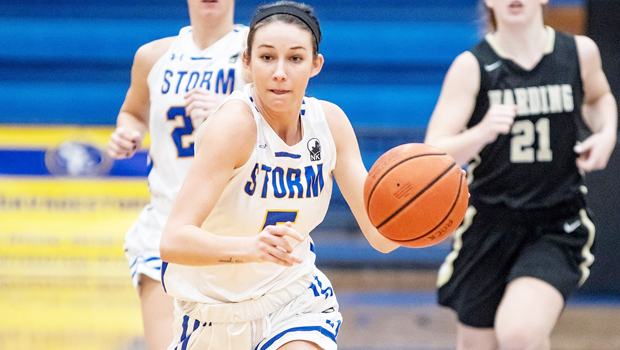
Seasons can end in what seems like a flash, but usually they happen during a game.
For Bowie alumnae Kamryn Cantwell, her Southeastern Oklahoma State team’s season ended right before it was to practice for the Division II Women’s Basketball Championship at the venue on March 12.
“We were dressed out in our practice gear with 20 minutes to go before practice started and we found out they had cancelled the Division I and II tournaments,” Cantwell said. “It was heartbreaking because we had gotten so far, and we’ll never know how far that team could have gone.”
The threat of COVID-19 was sweeping America that week, causing almost all sporting events at all levels to almost simultaneously cancel or postpone their seasons.
The National Collegiate Athletic Association made the call to cancel both the men’s and women’s basketball tournaments that coins the phrase March Madness due to its unpredictability. The NCAA also canceled all spring sports.
“As far as the spring athletes, I hate that for them because so many of them didn’t even get to get their season going,” Cantwell said. “I know that a lot of those kids will get another year from the NCAA, but I also know a lot of them already have plans next year.”
The Lady Storm were just coming off winning the Great American Conference tournament, a tournament where Cantwell was named the most valuable player after averaging 22.7 points and six rebounds a game.
With a 22-7 record and with three senior starters, including conference MVP Katie Webb, Southeastern Oklahoma State will never find out how far it could have gone in the NCAA tournament.
For Cantwell, it was an anticlimactic end to a great sophomore season for all intents and purposes, both for the team and her individually.
The point guard was second on the team scoring 15.8 points a game while shooting an efficient 47.2 percent from the field and 41.3 percent from 3-point land. Besides just scoring, she led the team with 3.7 assists and also collected 5.1 rebounds and 1.4 steals. She was named to the GAC conference first team list.
She did all of this while never missing a game and playing the second most minutes at one of the most demanding positions.
“We knew pretty much from day one she could fill that role,” SEOSU Coach Darin Grover said.
Cantwell was not sure what her role would be when recruited. Though she had played point guard at Bowie, the step up in responsibilities are usually not thrust on an incoming freshman.
“I played point guard in high school, but I was more expecting to be the (shooting guard) or (small forward), but when I got on campus, I just told myself I was going to fill whatever position they needed,” Cantwell said.
The only thing clear to her when recruited was she was expecting to contribute in some capacity early on.
With the departure of a key senior player at the position, someone needed to fill it and Grover was sure Cantwell could do it.
Besides a hiccup in her second game against Pittsburg State, it was clear early on Cantwell was going to be a key piece to the team right away. She scored in double figures in 11 of her first 12 games, starting everyone she played in. Though she was making it look easy, Cantwell said the transition was not as seamless as it seemed.
“I would say how much faster and physical the game is,” Cantwell said. “When you go in as freshman, everyone is bigger than you. You’re typically one of the smaller ones if you’re a guard.”
That physical play took a toll on her as she started having to play through a nagging pain in her shin. When it became too much for her to tough it out, she got it checked out and found out it was a stress fracture on her tibia.
That news ended her season halfway through. She had averaged 13.5 points a game, 5.4 rebounds and 2.9 assists.
Though it cut short what was turning out to be a promising freshman year, Cantwell made the most of a bad situation.
“On the flip side, a part of me is glad because I got to see a lot of things I hadn’t seen,” Cantwell said. “The whole time I was there playing, I started from the first game, so I got to sit back and observe and just watch the coaches and the players and what we were trying to accomplish offensively and defensively. So I think that really helped this year.”
“What Kam has done is just rare for a freshman,” Grover said. “To not just start, but to excel and then to have her season cut short and come back even better this year. We needed every bit of that.”
Some people are less surprised than others she has been this successful early on.
“I really thought she was an extremely special talent,” former Bowie Coach Chuck Hall said. “I have not been surprised at all by her success. She works so hard and you see the work pay off on the court.”
To read the full story, pick up a copy of the mid-week edition at the Bowie News.
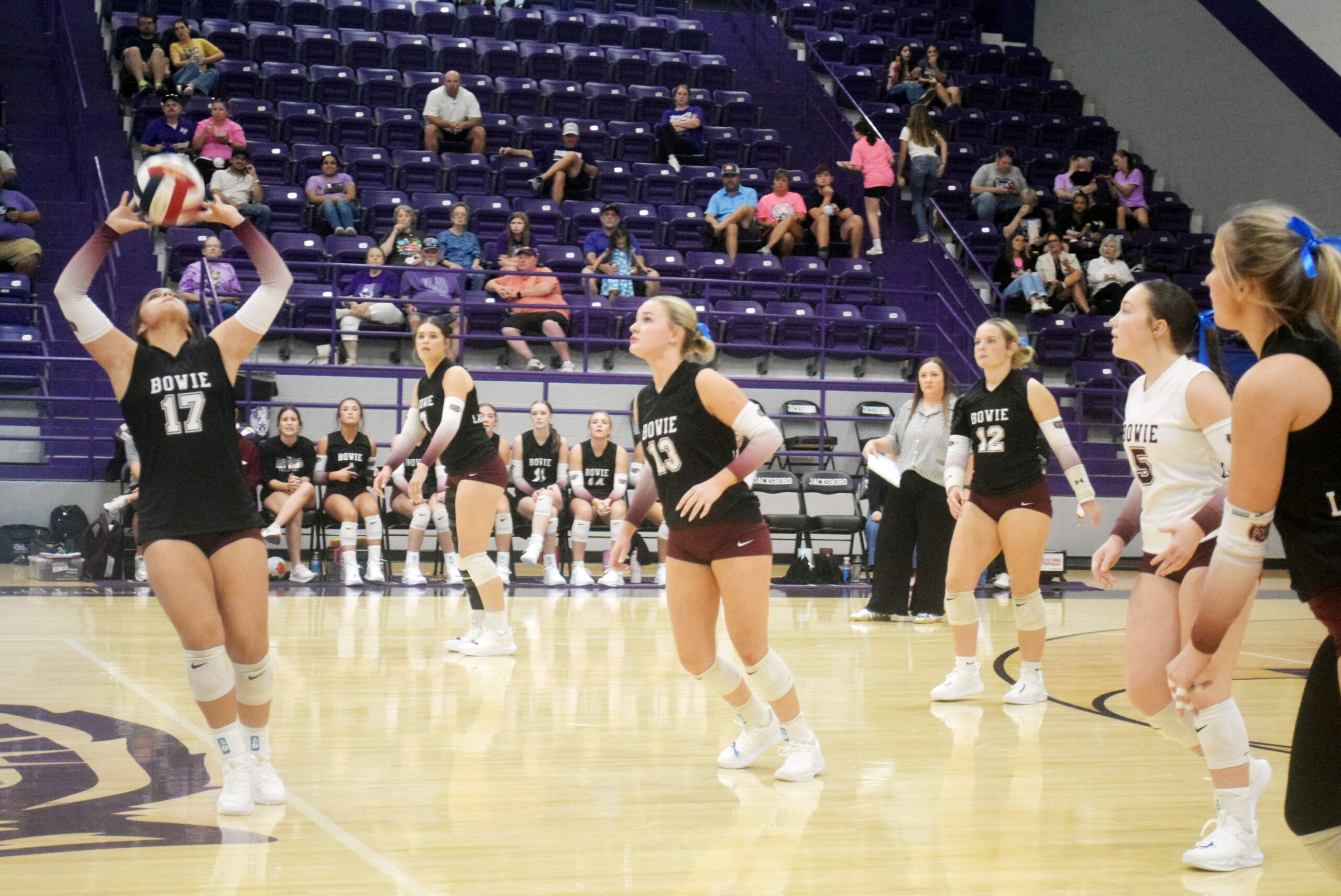
Bowie, playing on a short rest, held with host Jacksboro for most of the volleyball match Oct. 1, but the Tigerettes pulled away late and defeated the Lady Rabbits 3-1 (26-24, 12-25, 25-14, 22-25).
The match was scheduled for Oct. 2 but was moved. Both teams are now 2-2 in District 6-3A.
Jacksboro got out to a quick lead in game one before Olivia Stewart’s kill and a three-point Olivia Richey serving run put the visitors up 8-7. Junior Abby Reneau broke things open with a six-point string to give Bowie a 15-8 cushion and force Jacksboro into a timeout.
The Tigerettes came back and took an 18-16 lead. KP Rutherford’s kill broke the serve and allowed Molly Enlow to tie the game at 18.
For further details, pick up a copy of Thursday’s Bowie News.
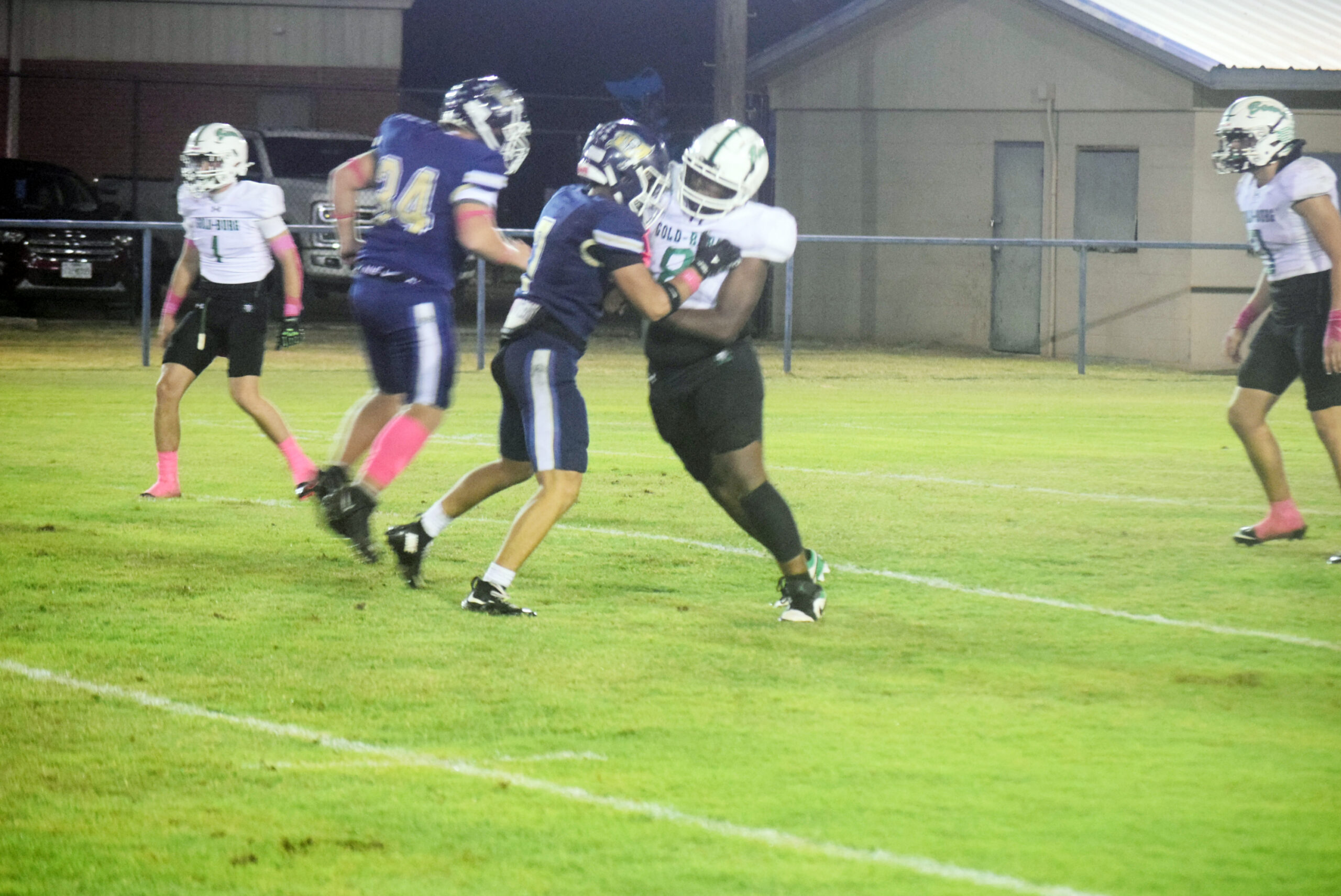
Gold-Burg Football Coach Austin Norman called his Bears’ 35-32 loss to host Perrin a “barn burner”.
It most definitely was as Gold-Burg, now 1-5 for the year gave the 5-1 Pirates everything they wanted for four quarters. Gold-Burg scored on the last play of the first half on a Peyton Epperson run with the two point conversion cutting the deficit to 20-16.
The Bears were their own worst enemy to open the third quarter with face mask and offside penalties moving the Pirates downfield setting up a first-and-goal at the Bear three. Defense by Epperson, Keelyn Case and Barrett Allen and a pair of Perrin penalties helped stop the drive and force a turnover on downs.
Gold-Burg was slapped with an intentional grounding penalty on the first play, giving Perrin a safety and extending the Pirate lead to 22-16. Defense by Epperson and JoJuan Grace after a first down run closed out the third quarter.
For further details, pick up a copy of Thursday’s Bowie News.
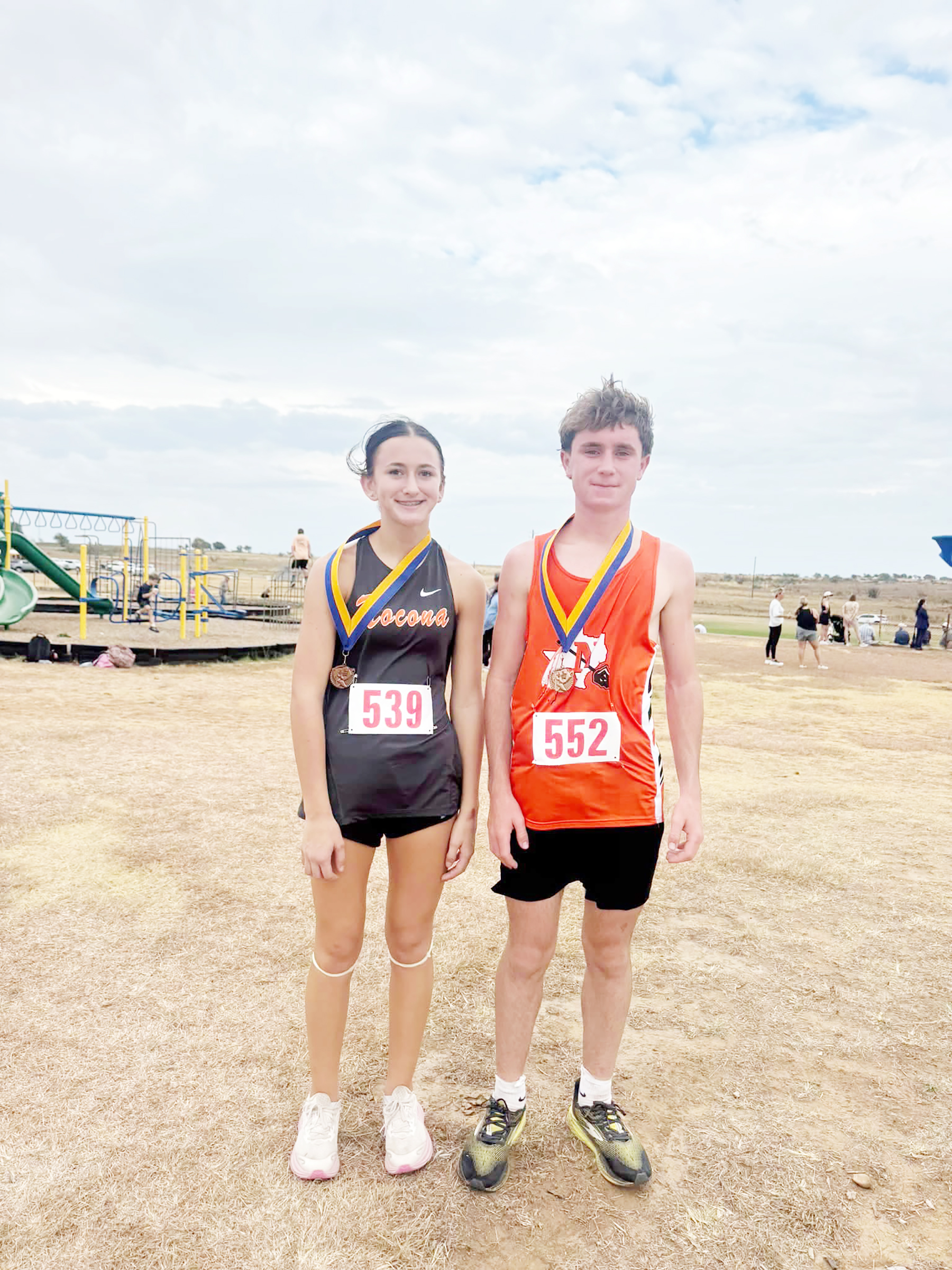
Nocona and Prairie Valley cross country teams took part in the Prairie Valley Invitational Sept. 20 while Bowie varsity runners competed in the Lubbock Invitational.
Lubbock
Leading the Rabbits was Kellen Rater who finished 10th among 162 runners with a time of 17:24.50. Finishing behind Rater was Shawn Willett with a time of 19:33.20. Hayden Sutton ran a 20:27.10 followed by Taven Melton in 20:39.20, Coleman Holloway in 20:53.80 and Jaxon Castro with a time of 21:31.60.
Laney Segura led the Lady Rabbits with a time of 14:41.30. She was followed by Kylee Waldrep in 15:56.80, Bella Lozano in 16:04.80, Angeles Alvarez with a time of 16:15.40, AnDee Miller in 16:23.70 and Isabella Caswell in 16:51 flat.
For further details, pick up a copy of Thursday’s Bowie News.






-

 NEWS3 years ago
Suspect indicted, jailed in Tia Hutson murder
-

 NEWS4 years ago
Wreck takes the life of BHS teen, 16
-
 NEWS4 years ago
2 hurt, 1 jailed after shooting incident north of Nocona
-
 NEWS3 years ago
SO investigating possible murder/suicide
-

 NEWS3 years ago
Murder unsolved – 1 year later Tia Hutson’s family angry, frustrated with no arrest
-
 Show us something good9 years ago
Country music star children perform in Bowie
-
 100th Birthday4 years ago
Looking back at the 1958 Centennial edition of The Bowie News
-
NEWS3 years ago
Sheriff’s office called out to infant’s death