
COUNTY LIFE
Palo Pinto County develops Community Wildfire Protection Plan to address risks


COLLEGE STATION, Texas — Palo Pinto County has adopted a plan to reduce risks and better prepare for wildfires.
Palo Pinto County, west of Fort Worth, is the 24th county to complete a Community Wildfire Protection Plan in Texas.
A Community Wildfire Protection Plan is a proven strategy for reducing the risk of wildfire to communities. The Palo Pinto County plan establishes goals and strategies for long-term success by identifying priorities and proposing immediate measures that will protect communities, especially those at highest risk, from wildland fire.
The plan was developed in cooperation with Palo Pinto County officials, local fire departments and representatives from Texas A&M Forest Service.
“With the signing and implementation of the Community Wildfire Protection Plan, we took a big step toward improving the safety and security of the citizens and visitors of Palo Pinto County,” said Ricky Hunter, Palo Pinto County Emergency Management Coordinator. “Wildfires will remain a threat, but this plan, and the involvement and support of the community, will help to lower that threat. I would like to thank all our volunteer fire departments, Palo Pinto County Emergency Services District 1 and Texas A&M Forest Service for their help in achieving this important goal.”
The county has been impacted by wildfires in recent years and is subject to Southern Plains Wildfire Outbreak events.
On April 9, 2011, conditions aligned to create a Southern Plains Wildfire Outbreak, which resulted in 144 wildfires burning more than 582,000 acres. The PK Complex ignited that day in extremely dry vegetation after 10 consecutive days with critical fire weather. The rugged terrain around Possum Kingdom Lake was also a major influence on fire behavior.
The wildfire burned uphill, causing it to travel rapidly and burn intensely, exposing homes along hilltops and ridges to some of the most extreme fire behavior that emergency responders observed that year.
The wildfire burned 126,734 acres in Palo Pinto, Young and Stephens counties and destroyed 168 homes. It is the 10th largest wildfire to burn in Texas since 1988.
The 2011 wildfire season in Texas was unprecedented, and wildfires have continued to threaten the communities of Palo Pinto County.
In 2022, the busiest fire year since 2011, 12,411 wildfires burned across Texas. Of that total, 123 wildfires burned in Palo Pinto County. The largest of these wildfires was the 11,598-acre Dempsey Fire, which threatened the town of Graford.
“Completing this plan is a great first step towards reducing the county’s risk from wildfire,” said Wes Moorehead, Texas A&M Forest Service Fire Chief. “By focusing on actions that improve preparedness and response to wildfire, Palo Pinto County can work towards becoming a more resilient community.”
Initial conversations and meetings for the Palo Pinto plan took place during the fall of 2021. As the 2022 wildfire year began, the need for a comprehensive plan was reinforced.
On March 3, the Palo Pinto County Community Wildfire Protection Plan was approved and signed by the County Commissioners and Texas A&M Forest Service.
To learn more about Community Wildfire Protection Plans and reducing your risk from wildfire, visit https://tfsweb.tamu.edu/ProtectYourCommunity/.
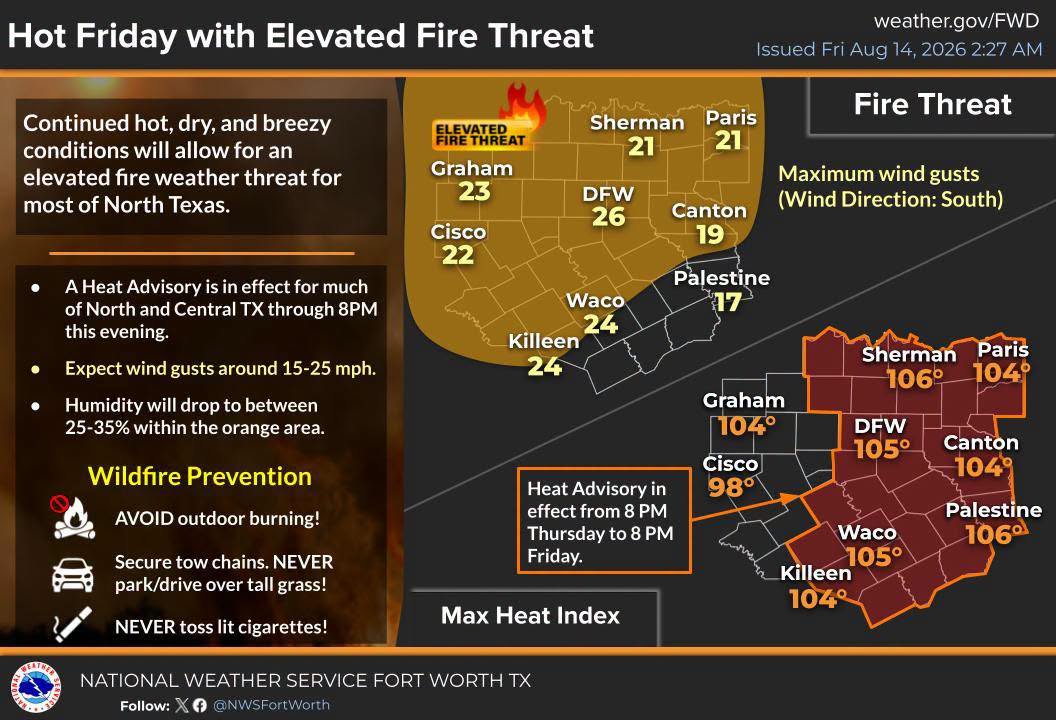
National Weather Service Fort Worth report: We’re closing down the work week with another round of HOT and DRY weather. Much of the area will see an elevated fire weather threat again today! A Heat Advisory remains in effect through 8 pm this evening. More heat headlines likely this weekend and early next week
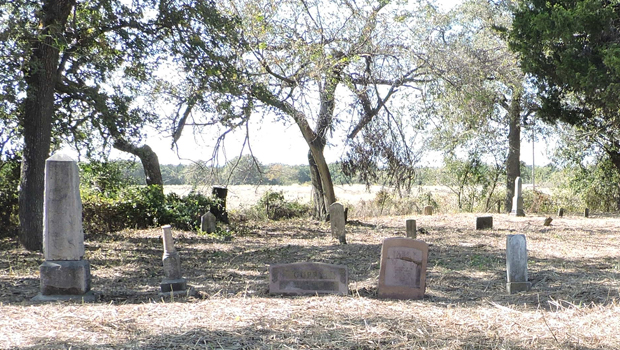
It’s time once again for the Montague County Cemetery Board Fish Fry.
The fish fry will begin serving at 5 p.m. on Aug. 22 at the Forestburg Community Center. The price is $10 per person for all you can eat, and child’s plate for 12 and under is $5. Take-out is also available.
The meal will consist of locally caught crappie and catfish, French fries, beans, hushpuppies, coleslaw and all the trimmings and homemade desserts.
The main purpose of the Montague County Cemetery Board is to look after the county’s abandoned cemeteries. The county has between 50 and 60 abandoned cemeteries. Cleaning a cemetery typically cost between $1,500 and $2,000. Any help is greatly appreciated. Help can be monetary, but it can also be as simple as reporting a suspected lost cemetery, allowing access to the cemetery, or spending a day alongside others cleaning. Volunteers are always welcome.
Another goal of the Cemetery Board is to obtain Historical Status from the Texas Historical Commission for the abandoned cemeteries. This status records the cemetery with both the county and state. It helps to protect them for years to come.

Leadership Montague County is now accepting applications for its upcoming class. Deadline to submit an application is Sept. 1.
Individuals who are interested in strengthening their leadership skills, expanding their knowledge of Montague County and building lasting professional and community relationships are encouraged to apply.
The program is a nine-month leadership development program consisting of nine, one-day, monthly meetings. Participants will explore topics including local government, agriculture, education, healthcare, business and industry, public safety, economic development and community leadership through interactive sessions and site visits. The group will be traveling to Austin in the spring to visit with the legislators and senators and to see how they work for the county residents.
Leadership Montague County is designed for emerging and established leaders who have a desire to become more involved in improving the quality of life throughout Montague County.
Class size is limited, and early application is encouraged. For additional information or to request an application, contact: Leadership Montague County, j-hansard@tamu.edu or call 940-894-2831
Follow us on Facebook on Leadership Montague County






-

 NEWS3 years ago
Suspect indicted, jailed in Tia Hutson murder
-
 NEWS4 years ago
2 hurt, 1 jailed after shooting incident north of Nocona
-
 NEWS3 years ago
SO investigating possible murder/suicide
-

 NEWS4 years ago
Wreck takes the life of BHS teen, 16
-

 NEWS3 years ago
Murder unsolved – 1 year later Tia Hutson’s family angry, frustrated with no arrest
-
 Show us something good9 years ago
Country music star children perform in Bowie
-
 100th Birthday4 years ago
Looking back at the 1958 Centennial edition of The Bowie News
-
NEWS3 years ago
Sheriff’s office called out to infant’s death