
NEWS
Gov. Abbott increases readiness level of state operations ahead of wildfire, severe weather threats


AUSTIN — Governor Greg Abbott today directed the Texas Division of Emergency Management (TDEM) to elevate the readiness level of the Texas State Emergency Operations Center (SOC) to Level II (Escalated Response) earlier this morning as the state braces for extremely critical wildfire conditions and severe weather threats. The Governor also added 33 counties to the state’s wildfire disaster declaration, which now totals 236 counties impacted by increased fire weather conditions. The list includes Montague, Jack, Clay, Wise and Cooke Counties and the rest of North Texas.
“Texas continues to monitor the heightened wildfire and severe weather threats that are expected to impact large portions of the state,” said Governor Abbott. “Today, I directed the Texas Division of Emergency Management to increase the readiness level of the State Operations Center to ensure resources and support are swiftly deployed to help Texans and local communities prepare and respond. High winds, low humidity, and dry vegetation increase the potential for wildfires to start in West, Central, and South Texas, and severe storms in North and East Texas will create hazardous conditions. Texans are urged to limit any activities that may cause sparks or flames, follow the guidance of state and local officials, and have an emergency plan to keep yourself and your family safe.”
According to the Texas A&M Forest Service, extremely critical fire danger is expected across large portions of West, Central, and South Texas, with very high wildfire danger expected across the western two-thirds of the state. High winds and low humidity contribute to fire intensities that are difficult to control. The Texas A&M Forest Service is monitoring conditions for the potential of a Southern Plains Wildfire Outbreak, a dangerous fire weather pattern that could develop under the current forecast. The Wildland Fire Preparedness Level remains at Preparedness Level 3, indicating that wildfire activity is impacting several regions of the state as the result of drought, dry vegetation, or frequent fire weather events.
Additionally, the National Weather Service is forecasting an increased risk of severe storms across North and East Texas through the end of the day. Hazards include tornadoes, damaging wind, large hail, and heavy rainfall that could lead to flash flooding.
At the direction of Governor Abbott, TDEM requested the following agencies report to the SOC and ensure their resources are ready to support local wildfire and severe weather response operations:
- Texas A&M Forest Service (Texas Intrastate Fire Mutual Aid System): More than 250 state and local firefighters, support personnel, fire engines, bulldozers, and motor graders; 33 federally-contracted firefighting aircraft, including 4 large air tankers, 15 single-engine air tankers for retardant drops, 4 air attack platforms for surveillance and spotting, 2 super scoopers for water drops, 4 helicopters with firefighting capability, 3 fire bosses for aerial guidance, and an air support module for aerial guidance
- Texas Division of Emergency Management: The State of Texas Incident Management Team to support deployed emergency response resources across the state
- Texas National Guard: Chinook and Blackhawk helicopters with firefighting capability
- Texas Department of State Health Services (Texas Emergency Medical Task Force): Wildfire and Severe Weather Support Packages consisting of medics, ambulances, and all-terrain vehicles
- Texas Department of Public Safety: Helicopters with hoist capabilities, Texas Highway Patrol Troopers, and the Tactical Marine Unit
- Texas Parks and Wildlife Department: Game Wardens, rescue boat teams, and helicopters with hoist capability to assist with flood rescues
- Texas A&M Engineering Extension Service (Texas A&M Task Force 1 and Texas Task Force 2): Type 3 Urban Search and Rescue Teams
- Texas A&M AgriLife Extension Service: Disaster Assessment and Recovery Agents as well as AgriLife Extension Agents to support agricultural and livestock needs
- Texas Animal Health Commission: Coordinating animal resource needs
- Texas Department of Agriculture: Coordinating agricultural resource needs
- Texas Department of Transportation: Personnel monitoring road conditions
- Public Utility Commission of Texas: Power outage monitoring and coordination with utility providers
- Railroad Commission of Texas: Monitoring of the state’s natural gas supply and communication with the oil and gas industry
- Texas Commission on Environmental Quality: Air/water/wastewater monitoring
- Texas Health and Human Services Commission: Personnel to provide information on available services through the 2-1-1 Texas Information Referral Network
- Texas Department of Information Resources: Monitoring technology infrastructure
Yesterday, Governor Abbott directed TDEM to activate additional state emergency response resources ahead of the extremely critical wildfire danger and severe weather threat.
Governor Abbott also encouraged Texans whose homes or businesses sustained damage from severe storms to report that damage using TDEM’s online damage survey. The Individual State of Texas Assessment Tool (iSTAT) damage surveys can be filled out in multiple languages at damage.tdem.texas.gov by selecting “March 4th Severe Weather.” The information shared through this voluntary tool helps emergency management teams assess the severity of damage and aids officials in connecting impacted Texans with available resources. The iSTAT tool is not a substitute for reporting damages to your insurance provider and does not guarantee disaster relief assistance.
Texans are urged to proactively prepare for impacts from wildfires and severe storms, stay informed of local risks, heed warnings of local officials, and pack an emergency supply kit. Visit TexasReady.gov for wildfire and severe weather safety information, tfsweb.tamu.edu for fire updates, and tdem.texas.gov/prepare for all hazards preparedness tips.

Trustees of the Bowie Independent School District will meet at 5:30 p.m. on Oct. 19 in the board room.
The meeting opens with several recognitions including teacher April Word and her theater students, junior high cross country girls, district champs and BJH boys runner-up.
Superintendent Donna Hale will report on attendance and enrollment, the intruder detection audit results, Jack County Appraisal District 2027 final budget allocation and monthly operational report.
Director of Student Service Jason Childress will offer the annual emergent bilingual report, followed by monthly reports from administrators.
In action items, a memo of understanding with the City of Bowie for use of the community center as a reunification location during emergencies will be reviewed. An emergency transportation agreement with Advanced Rehabilitation and Healthcare of Bowie also will be considered along with the 2026 tax roll totals.
An executive session also is scheduled.
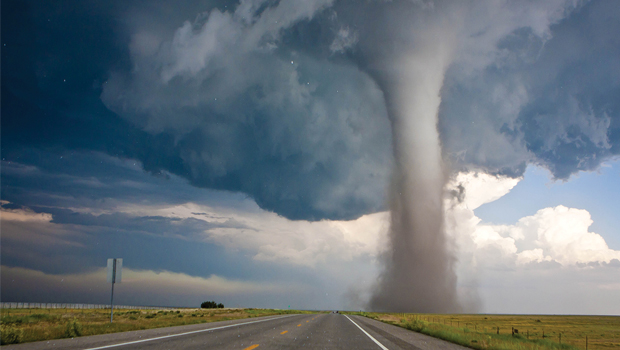
It appears tornado activity is shifting heightening risks in the south.
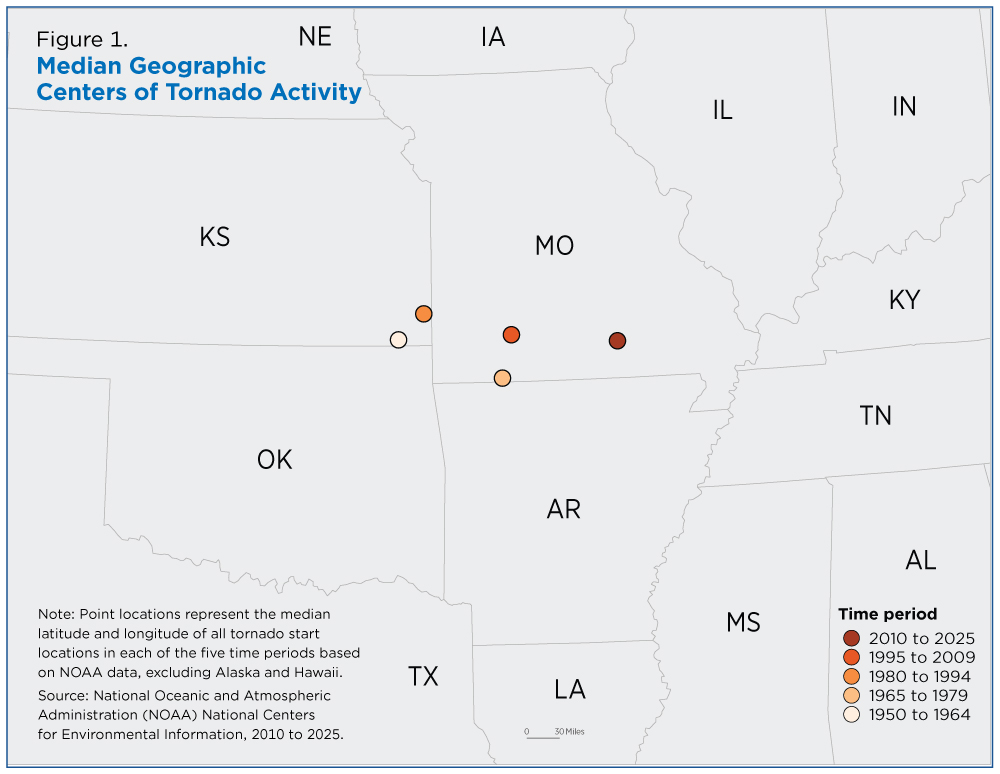
According to the United States Census Bureau 2025 was one of the nation’s most active tornado seasons on record, with approximately 1,559 tornadoes — 27% higher than the 30-year average from 1991–2020, according to the National Oceanic and Atmospheric Administration.
The number of tornadoes not only grew but shifted eastward during that period: tornado activity decreased in the west by 25% and increased in the east by 12%. This shift is especially concerning because tornadoes are now increasingly affecting southern states with a large concentration of mobile home communities.
The National Weather Service reports mobile home residents are 15 to 20 times more likely to be killed in a tornado than those living in site-built housing.
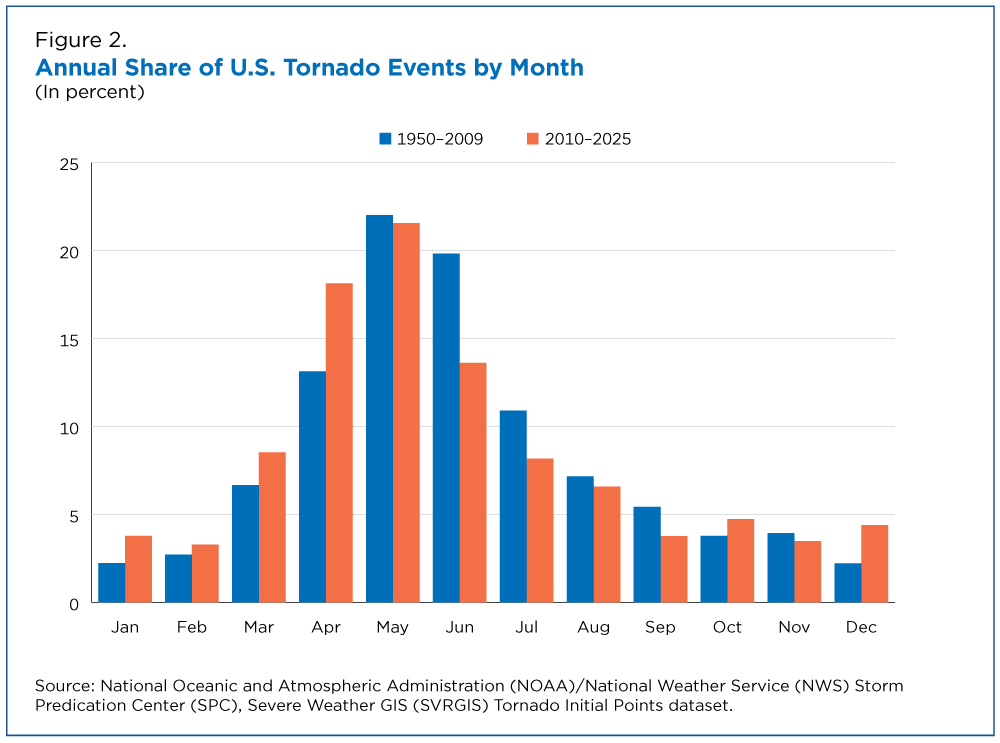
Tornado activity isn’t only shifting eastward – it’s breaking out of the traditional late-spring-into-summer season, now stretching into winter and early spring. Between 1950 and 2009, tornado activity was strongly concentrated in the spring months, when nearly two‑thirds of all tornadoes occurred between April and June.
From 2010 to 2025, tornado activity expanded, with higher tornado counts in January through April, and notable increases in October and December (Figure 2).
Summertime tornado activity dropped compared to 1950-2009. The tornado season now begins earlier, ramps up more gradually, and extends later into the year.
This growing threat of near year-round tornadoes is most pronounced in the South, particularly the Gulf Coast states of Alabama, Louisiana and Mississippi, where moisture-rich air creates an uninterrupted, seven-month tornado season in the cooler months.
Read more on this data and risks to certain communities at census.gov/ccontent/dam/Census/library/stories/2026/10/tornado alley.

The Montague County Grand Jury reviewed a total of 38 cases during its September session that included two no bills, nine indictments that remain sealed awaiting the arrest of a suspect.
The no bills indicate the grand jurors did not believe the case supported the charge. The cases were for evading arrest with a vehicle and possession of a controlled substance 1-4 grams.
The sealed cases cover a large gambit of charges including arson of a habitation/place of worship, unlawful possession of a firearm by a felon, indecency with a child sexual contact, cruelty non-livestock animals: kill/poison/serious bodily injury; injury to a child/elderly/disabled person with serious bodily injury mental, abandon/endanger a child criminal negligence, and sexual assault of a child.
Read the full story in your Thursday Bowie News.






-

 NEWS3 years ago
Suspect indicted, jailed in Tia Hutson murder
-
 NEWS4 years ago
Wreck takes the life of BHS teen, 16
-
 NEWS3 years ago
SO investigating possible murder/suicide
-

 NEWS3 years ago
Murder unsolved – 1 year later Tia Hutson’s family angry, frustrated with no arrest
-
 NEWS4 years ago
2 hurt, 1 jailed after shooting incident north of Nocona
-
 Show us something good9 years ago
Country music star children perform in Bowie
-
 100th Birthday4 years ago
Looking back at the 1958 Centennial edition of The Bowie News
-
NEWS3 years ago
Sheriff’s office called out to infant’s death