
HEALTHY LIVING
What’s causing your dark under-eye circles (and what experts swear will help)

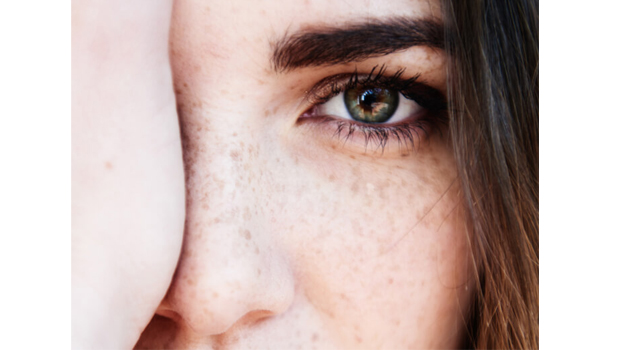
You’ve got to hand it to dark circles: Unlike many other skin issues, they don’t discriminate. You could start your day with a green juice and a facial and still end up with a serious case of the under-eye blues.
“They’re ubiquitous,” admits Deanne Mraz Robinson, MD, a dermatologist with Connecticut Dermatology Group. “You can find different aspects of [dark circles] in people from their early twenties, onward.”
The bad news is that genetics plays a big role (thanks, Dad!), plus the thinnest skin on your face is around the eyes, so you can often see blood vessels beneath it. But many of the other causes—sun damage, allergies, lack of sleep, cocktails, and salty snacks—are within your control.
Since pulling a Victoria Beckham and wearing oversized sunglasses for the entirety of your week isn’t a realistic option, we spoke with four top beauty experts who share 12 ways that you can take on dark under-eye circles—and win. —Rachel Brown
1. Pinpoint your problem
Tackling dark circles is easier when you get a handle on what you’re dealing with. Certainly, if you just pulled an all-nighter, it isn’t hard to determine the culprit. Most of the time, it won’t be that clear, but there are signs that can direct you to possible offenders.
Sun damage and visible blood vessels are greater problems for lighter-skinned people, explains Dr. Mraz Robinson, while those with darker skin are prone to inflammation-induced hyper-pigmentation. No matter your skin tone, there’s one thing you can’t stop and that’s aging; as you get older, your skin thins and, in the process, reveals the capillaries and plumbing underneath. But you also get wiser, so… trade-off?
2. Eat well, sleep well, repeat
Heart health, cancer prevention, stress reduction… There are many reasons to chug water in place of alcohol, get at least seven hours of sleep a night, and include as many anti-inflammatory fruits and vegetables into your diet as possible. And you can add eye de-puffing to that list.
“Under-eye circles are a symptom of internal issues in the body,” says Laurel Shaffer, herbalist and founder of skin-care brand Laurel Whole Plant Organics. If you’re going for an extra-big wine pour at your next dinner out, make sure your water glass is constantly being refilled, too.
3. Don’t be so thin skinned
Collagen boosters such as retinols, which are a form of vitamin A, increase cell turnover and generate firmer, thicker skin below the eyes. “The thicker the skin, the less visible those vessels will be,” says Dr. Mraz Robinson.
Natural skin-care products often use carrot oil, rosehip seed oil, or tamanu oil, which Shaffer loves for being super-packed with vitamin A. (Laurel Whole Plant Organics’ Eye Serum and Eye Balm, which both include rosehip seed oil, are a good place to start.)
4. Get your buzz on
Turns out, caffeine might perk up your skin, too. “It functions as a vasoconstrictor. Constricting the blood vessels around the eye area, in turn makes the dark circle and puffiness less visible,” says Lauren Hoffman, co-founder of eye-focused beauty brand Onomie (whose Bright Concealing Elixir features caffeine as one of its main ingredients). She also points out that, because of its antioxidant properties, the stimulant also excels at “protecting your skin from free radical damage and thus protecting against potential future aging.”
5. Address your allergies
Onomie’s Hoffman and Dr. Mraz Robinson note that allergies trigger inflammation, which does no favors for your under-eye area. So it goes without saying that, when you’ve got something you’d like to look bright-eyed for—a date, a wedding, a New Year’s Eve party—your best bet is to steer clear of known allergens altogether. When that’s not possible (because you are human), you can give over-the-counter antihistamines a shot, they say.
6. Be gentle
Abrasive cleansers and makeup removers can further aggravate dark circles. “If you’re using something that isn’t taking [product] off very well, then you’re irritating the eye and making the darkness worse,” says Christy Coleman, a makeup artist and head of creative design at non-toxic cosmetics brand Beautycounter.
She recommends the brand’s Routine Clean because “you don’t have to rub, and it removes makeup very well.” (These nine cleansers also get the Well+Good stamp of approval.)
7. Pile on the pillows
It’s not just how much you sleep that impacts dark circles, but how you sleep. Ditch those old, scratchy pillows you’ve been meaning to throw out anyway, and make a pillow pile with the ones you’ve got left to prop up your head. According to Dr. Mraz Robinson, “If you sleep a little elevated, it helps drain the swelling. When you lie flat, it’s more likely to pool.”
Massages are not just for your back
Natural beauty maven Laurel Shaffer advises compressing your face daily with a towel soaked in warm water, salt water, or herbal tea. “Compressing will absolutely reduce under-eye puffiness and improve darkness immediately,” she notes.
To achieve similar ends, Beautycounter’s Coleman favors light massages around the eyes with your fingers, with jade rollers, or stones. (New to DIY jade rolling? Here’s everything you need to know.)
8. Massages are not just for your back
Natural beauty maven Laurel Shaffer advises compressing your face daily with a towel soaked in warm water, salt water, or herbal tea. “Compressing will absolutely reduce under-eye puffiness and improve darkness immediately,” she notes.
To achieve similar ends, Beautycounter’s Coleman favors light massages around the eyes with your fingers, with jade rollers, or stones. (New to DIY jade rolling? Here’s everything you need to know.)
9. Choose your concealer wisely
The wrong cover-up shade can be particularly problematic when you’re coping with dark circles. “It might actually make that dark circle more pronounced and stand out on your face in a way that isn’t going to seem natural,” says Hoffman.
Coleman’s tip? Select a concealer a shade lighter than your foundation, to help brighten the area around your eyes. It always helps to go with an all-natural option, too.
10. Banish heavy eye shadow to your bathroom drawer
We’re not saying you should break up with smoky eyes for life… but maybe put down the kohl and the dark shadows for a little trick of the eye. “You want to keep [your eye makeup] brighter; that deflects from the dark circles underneath,” reasons Coleman.
She opts for shadows with shimmer or sheen for those occasions when a diversion tactic is necessary, and singled out Beautycounter’s pearl and champagne duo as a good option. “If you use a neutral peach-y beige to line the inner rim of your eye, that also helps,” Coleman adds.
11. The bold and the beautiful
Distraction can be a dark circle sufferer’s biggest ally. “If you wear a brighter or a darker lip, people are going to notice that before the dark circles,” promises Coleman. Besides, who doesn’t love an excuse to grab your go-to red lipstick on a Monday morning?
12. And, of course, don’t skimp on the sun protection
Grab a hat whenever you’re spending time in the sun, and Dr. Mraz Robinson recommends finding a delicate sunblock that you feel comfortable wearing regularly. “Sun protection is very important because pigmentation can become darker with sun exposure,” she says, noting skin-care products with vitamin C and licorice extract can be applied to combat hyperpigmentation.

y
(Feature Impact) The school year brings new classmates, routines and opportunities for children to learn about people whose experiences may be different from their own. They could include friends who use a wheelchair, carry an inhaler or even receive nutrition through a feeding tube.
Watch this video to learn more
For families who rely on tube feeding, it is an essential part of daily life but is often understood only by those who experience it. That limited awareness can leave children who are tube fed and their families feeling isolated or unseen, according to Gerard Minor, a pediatric gastroenterology and hepatology specialist.
Parents can use everyday questions as opportunities to help children understand there are many ways people receive nourishment. Teachers, classmates, caregivers and communities can also help make tube feeding part of the everyday conversation around childhood rather than something that separates children from it.
“Helping children understand those differences early can encourage curiosity, kindness and inclusion,” Minor said.
To help bring greater awareness, understanding and representation to children and families who experience tube feeding every day, Compleat, a leader in tube feeding formulas, launched “What Is Better Than How,” featuring “Sesame Street’s” Elmo and his signature warmth and curiosity. The original song celebrates the many ways people eat. Some people eat with a fork, some use a spoon and some use a tube, reinforcing a simple message: What matters is not how you eat. What matters is that you are nourished, loved and included.
To hear the song, create a personalized version and learn more about the campaign, visit Compleat.com/WhatIsBetterThanHow.

SOURCE:

(Feature Impact) Dry eye is one of the most overlooked symptoms of perimenopause, the phase of fluctuating hormones leading up to a woman’s final period, and menopause, the point in a woman’s life when she’s gone a year without a period.
In fact, 79% of women1 recognize hot flashes as a symptom of menopause, but only 14% recognize dry eye as a menopause-related symptom, according to the 2026 Bausch + Lomb (Peri)Menopausal Survey. What’s more, 78% of women1 were surprised to learn that dry eye is a symptom of perimenopause or menopause.
“Dry eye is still widely overlooked as a symptom of menopause, and many women think it’s just a minor nuisance, but the truth is it can significantly affect your daily life,” said Neda Gioia, OD, CNS, IFMCP, FOWNS, founder, Integrative Vision. “Early symptoms are often misunderstood or self-treated but it’s very important for women who experience symptoms to see an eye doctor and get an accurate diagnosis and treatment.”
During perimenopause and menopause, declining hormone levels can impact tear production, tear quality and tear evaporation, contributing to dry eye symptoms including redness, fluctuating vision and a gritty or tired feeling in the eyes, all of which can impact day-to-day comfort and quality of life. If left untreated, dry eyes may worsen over time, potentially impacting eye health and vision. Among peri-, menopausal and post-menopausal women who experienced dry eye, 80% said the symptom came as a surprise.
Respondents reported their dry eye symptoms caused difficulty reading (58%), difficulty using screens (53%), difficulty driving (26%) and reduced productivity (17%), underscoring the often-overlooked impact dry eyes can have on everyday life.1
However, there are a variety of products and treatment approaches available to help manage dry eye symptoms. For example, Bausch + Lomb offers a range of options designed to address the main causes of dry eye.
A doctor-recommended, clinically proven once-daily soft gel supplement that targets the key root causes of dry eyes, Blink NutriTears supports healthy tear production and provides lasting, continuous relief.* § As part of a comprehensive approach to dry eye management, the supplement can be used with Blink Triple Care Preservative Free Lubricant Eye Drops, which are designed to directly address tear evaporation, one of the leading causes of dry eye, and provide instant and long-lasting symptom relief.
An eye care professional can help determine the approach that’s right for each individual. To learn more about dry eye and products to help combat it, visit JustBlink.com.
| *These statements have not been evaluated by the Food and Drug Administration. This product is not intended to diagnose, treat, cure or prevent any disease. |
12026 Bausch & Lomb (Peri)Menopause Survey via Suzy, n=402; Women ages 30–80+ who are perimenopausal, menopausal, or post-menopausal
§Based on a clinical study

SOURCE:

(Sheeka Sanahori) Being an adult comes with a never-ending list of responsibilities: Cook dinner. Scrub the bathroom. File taxes. The tasks grow even longer when sharing a household with a partner, building a family, or taking care of others. No matter how you define “adulting,” getting life insurance tends to be one part of the to-do list that keeps getting set on a procrastination loop.
New survey data backs that up: there are plenty of other tasks adults would rather focus on first.
The Adulting Task Americans Keep Avoiding
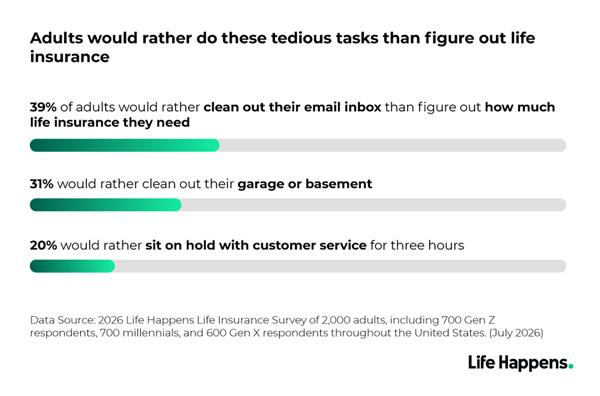
According to the 2026 Life Happens Life Insurance Survey, a financial literacy nonprofit organization, 39% of U.S. adults would rather clean out their email inbox than figure out their life insurance needs. Another 31% would rather clean out the garage or basement. One in five U.S. adults would be willing to sit on hold with customer service for three hours before life insurance planning. Even though many adults have it somewhere on their list, nearly half (46%) say they’ll either deal with it later or not at all.
They Know It Matters
Nearly a third of adults have already figured out a life insurance plan, and they feel good about their decision. Others are feeling more conflicted: 14% have a policy, but they’re not sure if they have enough. Another 12% say they either don’t know where to start or they think it’ll be too expensive.
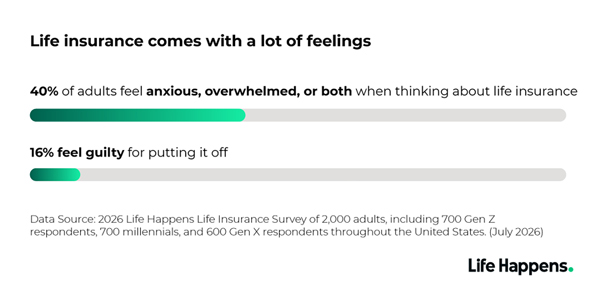
It’s no wonder people are putting it off: Navigating a new-to-them form of financial planning can come with a lot of complicated emotions. Four in 10 feel either overwhelmed, anxious, or some combination of both. Sixteen percent of U.S. adults feel guilty for putting it off, but when the outcome is more procrastination, that feeling lingers.
Why Later Keeps Winning
If you’ve ever faced an important decision without having enough information to make an informed choice, you know how stressful it can be. While the generations have different takes on making major decisions with a gut feeling or “pure vibes,” most of the time, people want to feel like they’re making an informed choice. Forty-five percent of U.S. adults say cost concerns, confusion or procrastination are the main reasons they have delayed or would delay looking into life insurance. For more than one in five, the plan is to seriously look at it when they feel more financially stable. For 12%, they say they’ll do it when they’re older.
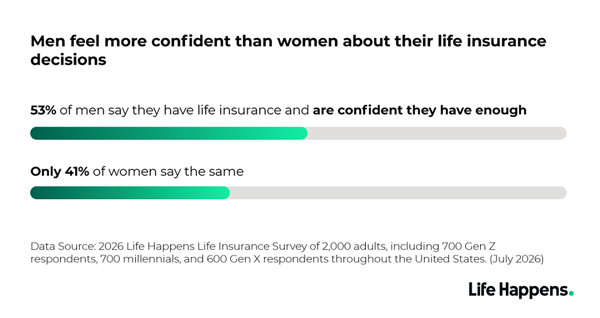
Men tend to feel more confident about their life insurance decisions to date; 53% of men vs. 41% of women feel confident their family would be financially protected.
The First Step Feels Bigger Than It Is
Learning more about life insurance, how it’s priced and how it works could help get many consumers out of their procrastination loop. A quarter of people say they’d make a decision if they learned it was easier to get than they previously thought. Thirty percent would make the purchase if they learned it was more affordable than they believed it to be. Others need an experienced professional to talk to or an online calculator tool to give them guidance.
Methodology: Life Happens commissioned Atomik Research to conduct an online survey of 2,000 adults, including 700 Gen Z respondents, 700 millennials, and 600 Gen X respondents throughout the United States. The margin of error for the overall sample is +/- 2 percentage points and +/- 4 percentage points for each generational sample, with a confidence level of 95 percent. Fieldwork took place between July 14 and July 20, 2026. Atomik Research, part of 4media group, is a creative market research agency.
Photo courtesy of Shutterstock (couple using computer)
SOURCE:






-

 NEWS3 years ago
Suspect indicted, jailed in Tia Hutson murder
-

 NEWS4 years ago
Wreck takes the life of BHS teen, 16
-
 NEWS4 years ago
2 hurt, 1 jailed after shooting incident north of Nocona
-

 NEWS3 years ago
Murder unsolved – 1 year later Tia Hutson’s family angry, frustrated with no arrest
-
 NEWS3 years ago
SO investigating possible murder/suicide
-
 Show us something good9 years ago
Country music star children perform in Bowie
-
 100th Birthday4 years ago
Looking back at the 1958 Centennial edition of The Bowie News
-
NEWS3 years ago
Sheriff’s office called out to infant’s death