
NEWS
Holiday shopping trends examined


The average shopper will spend $625 on holiday gifts this year, although one-third will stay under $400. Most shoppers (nearly 60%) plan to do their holiday shopping online. And women are more likely than men to be coupon-hunters.

These are just some of the insights we gathered during our 2018 holiday spending survey of 1,500 U.S. adults (via Google Surveys). This year, we collaborated with BlackFriday.com, the online authority on all things Black Friday to determine when consumers plan to start shopping, how they plan to shop and what they plan to spend.
Holiday gift budgets
Roughly one-third (32%) of American adults will stay under $400 when shopping for gifts. That’s down significantly from last year, when 41% said they planned to stay under $400.
Much of that change could be due to more shoppers moving into the no-gifts group: 17% say they won’t spend any money on gifts at all this year. That’s up from last year, when 6% of shoppers said they wouldn’t be spending a dime on holiday presents.
Relatively few (12%) will stray above $1,200, which is identical to last year’s results.
The average holiday shopper will spend $625 throughout the holiday shopping season this year.
How much will you spend on holiday gifts this year?
- Less than $400 – 32%
- $401-$800 – 25%
- $801-$1,200 – 14%
- $1,200+ – 12%
- I don’t plan to spend any money on gifts – 17%
Purchase-decision data
A variety of factors come together to influence whether a shopper clicks “Add to Cart” or even shops at a retailer in the first place. According to our survey, free shipping, price and quality are all major factors.
Free shipping is more important to consumers than other retailer perks
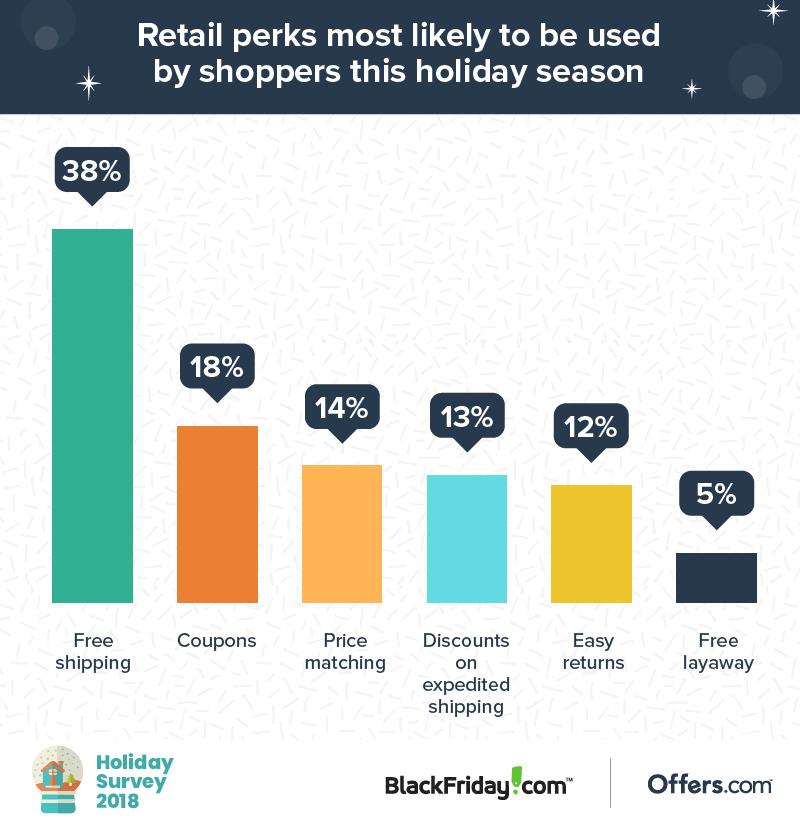
Retailers offer plenty of perks for shoppers, from free shipping, to easy returns, to price matching, to layaway. But the one customers care about the most (by far) is free shipping.
Lower prices most likely to lure customers to new stores
If stores want to attract customers who have never shopped at them before, they’ll need to do it through their price tags. The best price is, by far, the most likely factor to get shoppers to change their habits. Convenience comes in second place, despite the effort retailers like Walmart, Target and Amazon are putting into their curbside delivery, automated in-store pickup and even trunk-loading services.
Of those who plan to use retailer perks this holiday season, free shipping is the one they plan to use most. Coupons are a distant second:
What are your top motivators for shopping at a new store/online retailer during the holiday season?
- Better prices – 33%
- Convenience – 24%
- Fast/Free Shipping – 22%
- Coupons – 11%
- Exclusive products – 10%
 For gifts, though, quality wins out.
When buying a gift for someone else, consumers first weigh the quality of the product. It’s more important than even low price, for the second year in a row. Best price is still an increasingly important factor, though. Last year, 30% of shoppers said it was the most important factor in gift buying, while, this year, that percentage grew to 36%.
What most influences your purchase decisions when shopping for a gift?
- Quality of the Product – 44%
- Lowest Price – 36%
- Reviews – 31%
- The Retailer’s Reputation – 16%
- Friend’s opinions/Friend’s shop there – 14%
- Social Media – 6%
A brand’s social media presence, meanwhile, is a relatively minor factor. But women are slightly more likely (7%) than men (5%) to take it into account.
Shoppers in the mood for something new plan to shop local
Among shoppers who are willing to try new stores during the holidays this year, more than half say they’ll try a new local business:
Which types of new retailers are you likely to try this holiday season?
- Local stores/businesses – 56%
- Websites/e-retailers I haven’t visited before – 15%
- Seasonal/pop-up stores – 11%
- Social media home-based business (Etsy, etc) – 10%
- National chains I’ve never tried – 8%
Holiday coupon usage and deal hunting
Most holiday shoppers plan to search for deals and coupons before making a purchase. In fact, nearly 50% plan to do so most of the time or every time.
How often do you search for deals and coupons when holiday shopping?
- Most of the time – 25%
- Every time – 24%
- Sometimes – 22%
- Never – 16%
- Rarely – 13%
Women are the most likely coupon-hunters: 30% of them say they will search for a coupon every time they make a purchase, versus 18% of men.
When it comes to snagging deals this holiday season, shoppers have high hopes for tech items. Tech is by far the category consumers most expect to have the best deals.
Which category do you think will have the best deals this holiday season?
- Tech – 51%
- Clothes – 22%
- Toys – 20%
- Houseware – 16%
- Travel – 10%
- Other – 2%
Online shopping trends and mobile usage
Most shoppers say they’ll shop online (whether on a laptop, tablet, phone or desktop). Meanwhile, 39% will shop in stores. The 25-to-34 age bracket is the most likely to shop on their phones: 27% of them say they’ll use their phones to shop this season.
How do you plan to shop this holiday season?
- Online, on a laptop or desktop computer – 39%
- Online, on a smartphone or tablet – 22%
- In-store – 39%
When consumers plan to start shopping
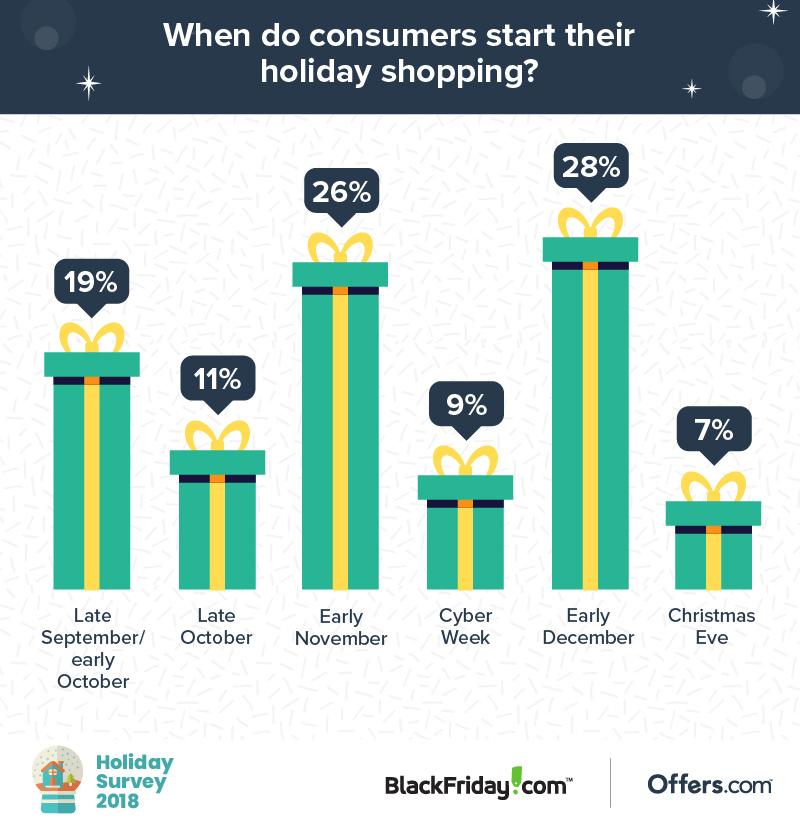
More than half of holiday shoppers plan to get started before Black Friday and Cyber Monday.
As with last year, women tend to be the earliest shoppers, while men tend to be the biggest procrastinators. The most common response to “When will you start shopping” among women was early November (29%). Meanwhile, the most common response for men (31%) was early December.
The largest contingent of young shoppers (ages 18 to 24), meanwhile, starts early. Nearly one-fourth of them (24%) plan to start gift shopping in early November.

Members of the Bowie City Council will face a brief agenda when they meet at 6 p.m. on Oct. 13 in the council chambers.
Following routine reports and consent agenda items, the council will consider a resolution authorizing submission of the city’s 2027/2028 Texas Community Development Block Grant application to the Texas Department of Agriculture.
Then council members will consider approving Bob Blackburn for appointment as a reserve police officer with the Bowie Police Department.
Following an executive session, the council will discuss and potentially take action regarding the annual employment evaluations and duties of both the City Secretary and the Municipal Court Judge.

After nearly three months of no rain, Mother Nature brought the showers this past week.
Downtown Bowie rain reports varied from 7 to 8 inches, while the Saint Jo area reported a 10-inch total. The city water plant in Bowie reported 5.55 inches on Sept. 30 with 1.6 Oct. 1-3.
Nocona saw a total of 6.31 inches of rain across Sept. 26 to Oct. 3.
On Oct. 6, Lake Amon G. Carter saw a level of 917.39 mean sea level rising to 81.31% full. Just one week earlier the lake was 73.6% full, while one year ago it was 94.01%. The lake is full at 920msl.
Lake Nocona was 73.7% full at 823.02 on Oct 6. One week earlier it was 70.41% full and one year ago it was 92.41%. The lake is full at 827.5 msl.

By BARBARA GREEN
editor@bowienewsonline.com
One Montague County City has joined the battle against any data centers being built in this county and there is a petition drive underway to urge the commissioner’s court to keep data centers out of Montague County.
At a Sept. 28 called meeting of the Saint Jo City Council, officials unanimously approved a resolution stating its opposition to the “siting, permitting, construction or operation of data centers and similar hyperscale computing facilities within the city limits or the city’s extraterritorial jurisdiction.”
City Secretary Debbie Dennis said several citizens approached Councilor Jack Dunn about their data center concerns and he helped prepare a resolution. The council gave unanimous support.
Read the full story in your Thursday Bowie News.






-

 NEWS3 years ago
Suspect indicted, jailed in Tia Hutson murder
-

 NEWS4 years ago
Wreck takes the life of BHS teen, 16
-
 NEWS4 years ago
2 hurt, 1 jailed after shooting incident north of Nocona
-

 NEWS3 years ago
Murder unsolved – 1 year later Tia Hutson’s family angry, frustrated with no arrest
-
 NEWS3 years ago
SO investigating possible murder/suicide
-
 Show us something good9 years ago
Country music star children perform in Bowie
-
 100th Birthday4 years ago
Looking back at the 1958 Centennial edition of The Bowie News
-
NEWS3 years ago
Sheriff’s office called out to infant’s death