
SPORTS
Comorants are here for the winter


By Luke Clayton
Love them or hate them, cormorants have flocked to lakes and private waters in Texas to spend the winter months roosting on standing timber on our lakes and devouring both baitfish and gamefish as though there is no tomorrow. With their sharp hooked bill and ability to remain underwater for extended time, they are very efficient fishers. They are well known for decimating the game fish population in private waters.
I first learned about cormorants and their fish catching ability nearly forty years ago while in Japan with a company that was establishing a mail order lure business there. Back then bass fishing was a craze with affluent Japanese and expensive bass boats from the US were commonly seen on private waters in Japan.
My job was to cover a fishing match between Rex Bridges, a popular Texas angler and Soramachi, the then reigning bass champion. IJ spend a couple days fishing with the outdoor writers for the Tokyo newspaper. One of them who spoke pretty good English pointed out a flock of cormorants and told me many of the older men trained the birds to catch fish for them. They tied a little noose around the bird’s neck to allow them to catch and swallow small fish, but the larger fish were caught in a pouch on the bird’s throat, to be eaten by the fishermen. We stopped fishing long enough to observe an old gentle with about six cormorants on leads. I think he was doing guided tours with his birds for tourists. What I remember most is when the birds surfaced, he pulled them inside the boat and they ‘coughed up’ some good-sized fish for the old gentleman.
Back in those days, cormorants were not nearly as prevalent in Texas waters during the winter as they are today. I assume worldwide, their numbers are threatened. They are currently protected by the Federal government but tell that to a landowner that has just had his summer stocking of largemouth bass eaten by a flock of cormorants!
I guess by now you have surmised I’m not fond of our winter feathered visitors. I like to catch and eat the same thing they do but I follow creel limits-the cormorants do not! But the cormorants have helped lead me to many winter catfish cookouts. How might you ask? A couple decades ago, a fishing guide invited me to go SPLATTING with him and write a column for the newspapers. Splatting, he explained, was fishing around standing timber in the shallow end of the lake. The birds roost in the dead trees at night and their dropping literally whitewash the limbs. Their droppings attract both blue and channel catfish in large
numbers and catching is often red hot during the first couple hours of daylight each morning.
Splatting is the perfect term to describe this method of fishing. Usually from 30 or so yards away, far enough so as not to spook the fish, baits set shallow under a floater are cast up close to the trunk of the tree. The baits make a “SPLAT” when they hit the water, letting nearby fish know that a cormorant has again send breakfast his way. A bit gross I know but it’s a fact of nature. Catching fish under the cormorant roost trees caught on quickly and most savvy catfish anglers today know the technique. Many use the heavy weighted popping corks used on the coast for speckled trout.
If you’re a cork watcher and have never experienced a morning of splatting, I suggest you put it on your to-do list. The bite is not tentative like a sunfish biting a nightcrawler or crappie nibbling a minnow, When the sound of food hitting the surface is telegraphed down through the water column to catfish, they make a beeline for the surface and it’s first come, first served! I’ve watched several greedy catfish fighting near the surface for the bait. It’s best to rig with at least 20-pound test line and a rod and reel strong enough to handle a big blue. It’s not uncommon to catch trophy catfish using this method but most will be in the 3-to-10-pound range.
Splatting is a run and gun style of fishing. Usually, two or three fish will be landed around each roost tree and then it’s time to bump the trolling motor and head to the next tree. Usually, the action begins to slow after a couple hours of sunshine but on cloudy days, it’s often possible to continue catching fish throughout the day but not nearly as well as the early morning bite. Catfish are opportunistic feeders, and they learn when the food supply is best, after the birds have spend a night in the roost tree dropping partially digested baitfish into the water.
When it comes to bait choices for splatting, the sky’s the limit. It’s hard to beat chunks of cut bait from rough fish or shad or even pieces of cut sunfish. Punch baits also work well, they just don’t stay in the hook as well as cut bait for reparative casts. It’s important to keep maximum pressure on the fish as soon as he’s hooked. Chances are very good there will be lots of submerged limbs to get your line snagged on. This is where stout rods with plenty of backbone and reels with strong drag systems come into play. If you’re in the mood for a big meal of fried catfish at deer camp, this is a good winter pattern that is sure not to disappoint you, let the cormorants mark the trees you need to fish beneath. Visit Luke’s website www.catfishradio.org Check out his weekly podcast “Catfish Radio with Luke Clayton and Friends” just about everywhere podcasts are found.
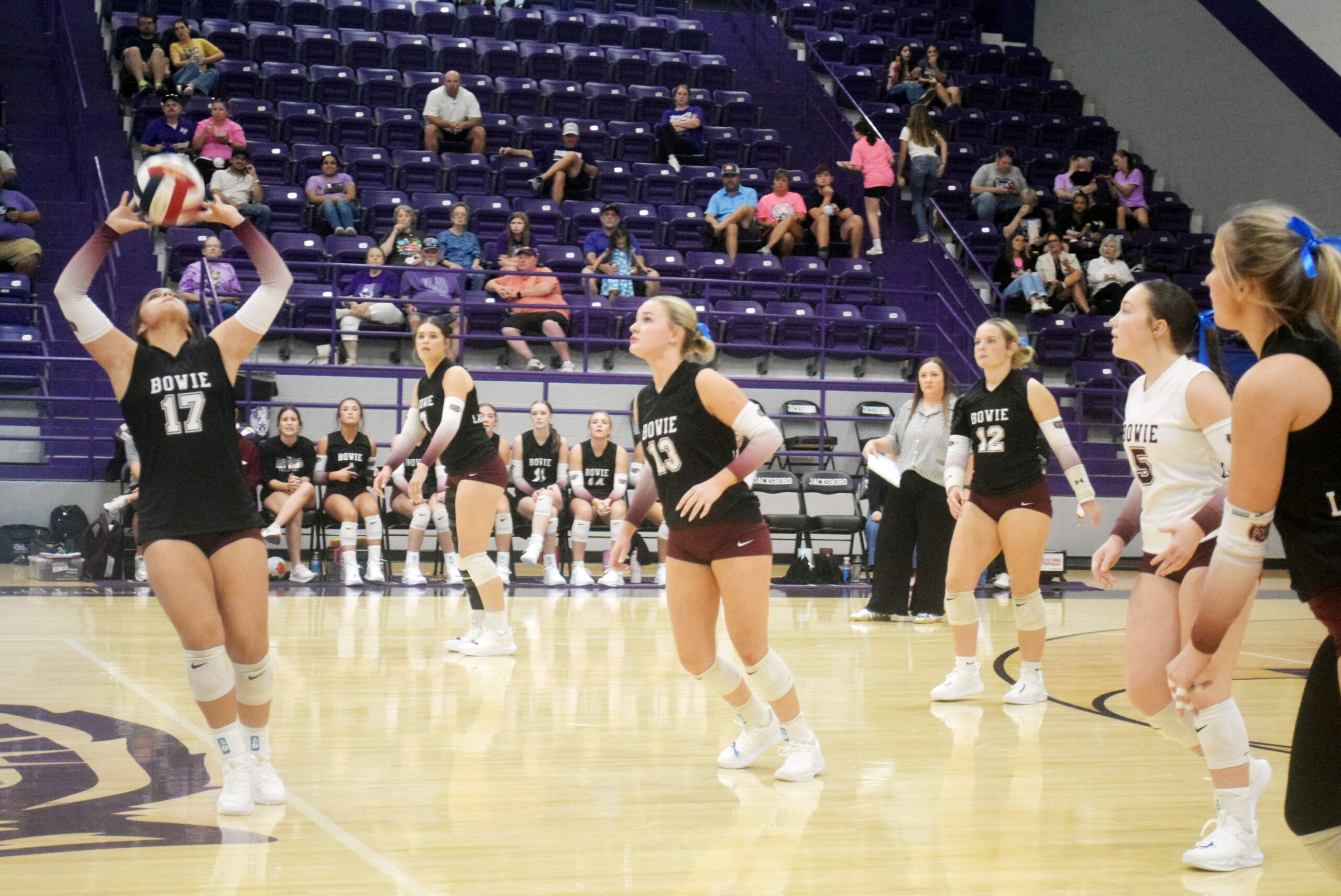
Bowie, playing on a short rest, held with host Jacksboro for most of the volleyball match Oct. 1, but the Tigerettes pulled away late and defeated the Lady Rabbits 3-1 (26-24, 12-25, 25-14, 22-25).
The match was scheduled for Oct. 2 but was moved. Both teams are now 2-2 in District 6-3A.
Jacksboro got out to a quick lead in game one before Olivia Stewart’s kill and a three-point Olivia Richey serving run put the visitors up 8-7. Junior Abby Reneau broke things open with a six-point string to give Bowie a 15-8 cushion and force Jacksboro into a timeout.
The Tigerettes came back and took an 18-16 lead. KP Rutherford’s kill broke the serve and allowed Molly Enlow to tie the game at 18.
For further details, pick up a copy of Thursday’s Bowie News.
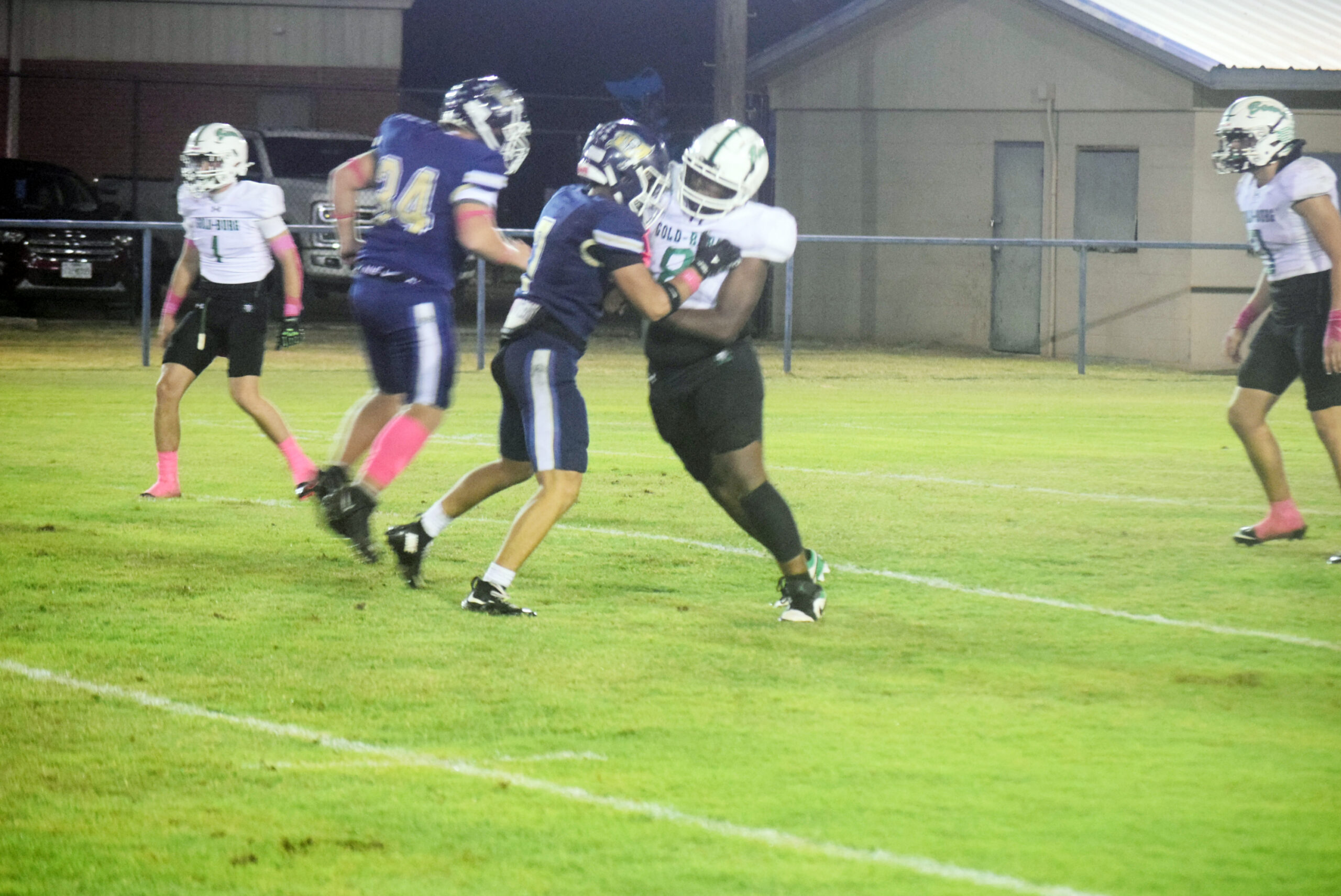
Gold-Burg Football Coach Austin Norman called his Bears’ 35-32 loss to host Perrin a “barn burner”.
It most definitely was as Gold-Burg, now 1-5 for the year gave the 5-1 Pirates everything they wanted for four quarters. Gold-Burg scored on the last play of the first half on a Peyton Epperson run with the two point conversion cutting the deficit to 20-16.
The Bears were their own worst enemy to open the third quarter with face mask and offside penalties moving the Pirates downfield setting up a first-and-goal at the Bear three. Defense by Epperson, Keelyn Case and Barrett Allen and a pair of Perrin penalties helped stop the drive and force a turnover on downs.
Gold-Burg was slapped with an intentional grounding penalty on the first play, giving Perrin a safety and extending the Pirate lead to 22-16. Defense by Epperson and JoJuan Grace after a first down run closed out the third quarter.
For further details, pick up a copy of Thursday’s Bowie News.

Nocona and Prairie Valley cross country teams took part in the Prairie Valley Invitational Sept. 20 while Bowie varsity runners competed in the Lubbock Invitational.
Lubbock
Leading the Rabbits was Kellen Rater who finished 10th among 162 runners with a time of 17:24.50. Finishing behind Rater was Shawn Willett with a time of 19:33.20. Hayden Sutton ran a 20:27.10 followed by Taven Melton in 20:39.20, Coleman Holloway in 20:53.80 and Jaxon Castro with a time of 21:31.60.
Laney Segura led the Lady Rabbits with a time of 14:41.30. She was followed by Kylee Waldrep in 15:56.80, Bella Lozano in 16:04.80, Angeles Alvarez with a time of 16:15.40, AnDee Miller in 16:23.70 and Isabella Caswell in 16:51 flat.
For further details, pick up a copy of Thursday’s Bowie News.






-

 NEWS3 years ago
Suspect indicted, jailed in Tia Hutson murder
-

 NEWS4 years ago
Wreck takes the life of BHS teen, 16
-
 NEWS4 years ago
2 hurt, 1 jailed after shooting incident north of Nocona
-

 NEWS3 years ago
Murder unsolved – 1 year later Tia Hutson’s family angry, frustrated with no arrest
-
 NEWS3 years ago
SO investigating possible murder/suicide
-
 Show us something good9 years ago
Country music star children perform in Bowie
-
 100th Birthday4 years ago
Looking back at the 1958 Centennial edition of The Bowie News
-
NEWS3 years ago
Sheriff’s office called out to infant’s death