
NEWS
Pandemic drive record unemployment


(AUSTIN) — Businesses across Texas and the nation have been forced to curtail or cease operations in the face of the coronavirus pandemic, throwing millions out of work and prompting a record increase in unemployment claims that is straining the safety net for workers. Nearly 2 million people in Texas filed for unemployment insurance benefits from March 14 through May 9, triple the number of claims filed in all of 2019.
In this issue of Fiscal Notes, we take an early look at the economic pressures now gripping the state. We also examine early impacts on employment and several other measures that can shed some light on current conditions.
“It’s far too early to say how long these conditions will last — and how deep the trough will go,” Texas Comptroller Glenn Hegar said. “Many economic measures are only beginning to reflect the crisis. It will be months before we can chart its full dimensions. Fortunately, our state’s fiscal position is strong enough to support vital programs for the remainder of this year, and our state’s “Rainy Day Fund” remains healthy. But the legislative session that begins in January 2021 will face significant and perhaps unprecedented challenges.”
Getting Texans back to work will no doubt be one of the bigger challenges. A record 315,167 Texans filed initial jobless claims during the week ending April 4; a comparable week in 2019 saw about 13,000 claims. The spiraling unemployment rate has forced the Texas Workforce Commission to ramp up its web-based and telephone systems, boost staffing and extend operating hours to ensure claimants get the benefits due them.
The May issue of Fiscal Notes also considers the history of previous recessions and their effect on tax revenues. The current situation is unprecedented in the speed with which it took effect, but the past does provide some important clues for our future.
For questions about how our tax functions are continuing during the outbreak, visit our COVID-19 News page or our Virtual Field Office. Fiscal Notes is available online and can be received by subscribing via the Comptroller’s website.
Fiscal Notes furthers the Comptroller’s constitutional responsibility to monitor the state’s economy and estimate state government revenues. It has been published since 1975, featuring in-depth analysis concerning state finances and original research by subject-matter experts in the Comptroller’s office.

After nearly three months of no rain, Mother Nature brought the showers this past week.
Downtown Bowie rain reports varied from 7 to 8 inches, while the Saint Jo area reported a 10-inch total. The city water plant in Bowie reported 5.55 inches on Sept. 30 with 1.6 Oct. 1-3.
Nocona saw a total of 6.31 inches of rain across Sept. 26 to Oct. 3.
On Oct. 6, Lake Amon G. Carter saw a level of 917.39 mean sea level rising to 81.31% full. Just one week earlier the lake was 73.6% full, while one year ago it was 94.01%. The lake is full at 920msl.
Lake Nocona was 73.7% full at 823.02 on Oct 6. One week earlier it was 70.41% full and one year ago it was 92.41%. The lake is full at 827.5 msl.

By BARBARA GREEN
editor@bowienewsonline.com
One Montague County City has joined the battle against any data centers being built in this county and there is a petition drive underway to urge the commissioner’s court to keep data centers out of Montague County.
At a Sept. 28 called meeting of the Saint Jo City Council, officials unanimously approved a resolution stating its opposition to the “siting, permitting, construction or operation of data centers and similar hyperscale computing facilities within the city limits or the city’s extraterritorial jurisdiction.”
City Secretary Debbie Dennis said several citizens approached Councilor Jack Dunn about their data center concerns and he helped prepare a resolution. The council gave unanimous support.
Read the full story in your Thursday Bowie News.

Montague County Judge Kevin Benton has signed an order lifting the outdoor burn ban effective Oct. 7.
Persons are still urged to be cautious when they are out working in the countryside to avoid any spark that could cause a wildfire.






-

 NEWS3 years ago
Suspect indicted, jailed in Tia Hutson murder
-
 NEWS4 years ago
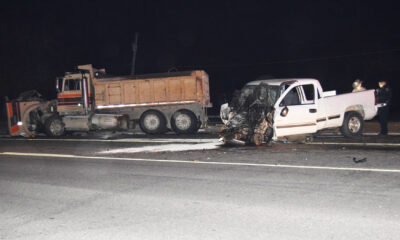
Wreck takes the life of BHS teen, 16
-
 NEWS4 years ago
2 hurt, 1 jailed after shooting incident north of Nocona
-
 NEWS3 years ago
SO investigating possible murder/suicide
-

 NEWS3 years ago
Murder unsolved – 1 year later Tia Hutson’s family angry, frustrated with no arrest
-
 Show us something good9 years ago
Country music star children perform in Bowie
-
 100th Birthday4 years ago
Looking back at the 1958 Centennial edition of The Bowie News
-
NEWS3 years ago
Sheriff’s office called out to infant’s death