
NEWS
Demand for live Christmas trees continues to rise

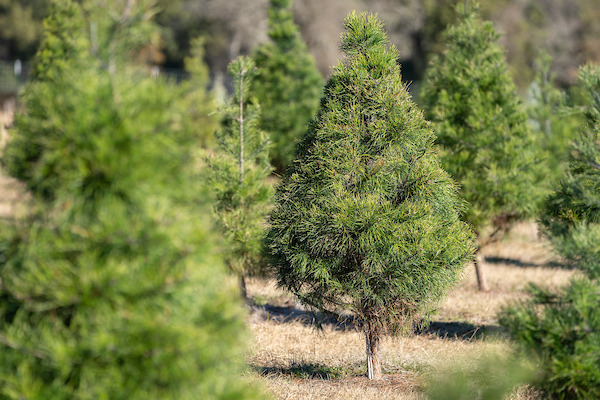
Demand for Texas-grown Christmas trees continues to rise as acreage and entrepreneurial interest in farms expands, according to a Texas A&M Forest Service expert.
Texas Christmas tree farms continue to see high demand for choose-and-cut trees. (Laura McKenzie/Texas A&M AgriLife)
Fred Raley, Ph.D., Texas A&M Forest Service director of the Western Gulf Tree Improvement Program, said Texas Christmas tree producers fared well this year after back-to-back seasons of drought for much of the state. He said consumers should expect higher prices for choose-and-cut and shipped cut trees this holiday season.
“Demand is up, whether the previous seasons impacted supplies or supplies held steady, so there is a potential for price increases and limited selection,” he said. “The increased cost of shipping in fresh-cut trees from other states will also factor into prices.”
Growers, farms diversify around Christmas trees
Raley said the impact of drought depended on localized rainfall and growers’ access to irrigation. Some farms are supplementing their native tree stocks with more shipped trees this year.
“If you want a live tree, my advice would be to get one early for the best selection,” he said.
Raley said sales typically kick off the weekend following Thanksgiving. Farms have been busy ordering trees and preparing their farms for sales season. In North Carolina, tree damage and impassable roads were concerns regarding Christmas tree supplies following the flood damage from Hurricane Helene. However, there was limited damage following the storm to farms and roads have been restored.
Texas producers continue to expand their acreage where they can, Raley said. Many choose-and-cut farms are also diversifying their operation with “experiential services” built around Christmas trees like hayrides, do-it-yourself decoration/wreath making and games.
“They’re trying to build a complete seasonal experience,” he said. “We’re seeing some older generational farms closing, but we’re also hearing from younger entrepreneurs who want to do something in the green industry, and they are looking to start with Christmas trees.”
Demand for replacement seedlings continues to rise
Stan Reed, executive secretary of the Texas Christmas Tree Growers Association, said the organization is seeing similar expansion and diversification trends in the industry across Texas. He estimates there are 85-95 tree farms in Texas that range from small “mom and pop” growers-sellers to 60-70-acre operations.
“Texas doesn’t have any growers who serve the wholesale market, but there are two operations that are poised to enter that market, which will serve local-cut live-tree stands,” he said.
Reed said new information and methods are helping growers increase production and limit setbacks like lost seedlings. There are four primary tree varieties that perform well in Texas growing conditions – Virginia and Afghan pines, and Leyland and Carolina sapphire cypresses.
Christmas trees in Texas are typically grown in four-year rotations, he said. The association sells seedling Virginia pine trees started from seed banks created by the Texas A&M Forest Service at a discount to growers.
Reed said growers have purchased around 130,000 seedlings so far for their upcoming replants.
Growers have been encouraged to buy more trees than they will plant to replace the season’s harvest. Those excess trees are kept as potted trees and are available to replace seedlings that do not establish and survive. Over the years, Reed said some growers have begun taking advantage of keeping trees potted longer to expedite their growth and shorten their harvest time to three years.
Raley said the seedling program started in the early 2000s, and research trials around the state have identified trees and varietal germplasm that are resilient and perform best. Seed from selected high performers grafted in seed orchards are used to create the seedlings supplied through the association.
“That program is about continuous improvement, and our goal is to meet or exceed the demand of growers each season,” Raley said. “That’s become a challenge because those numbers keep going up every year, but we want to continue to see that trend.”

Members of the Bowie City Council will face a brief agenda when they meet at 6 p.m. on Oct. 13 in the council chambers.
Following routine reports and consent agenda items, the council will consider a resolution authorizing submission of the city’s 2027/2028 Texas Community Development Block Grant application to the Texas Department of Agriculture.
Then council members will consider approving Bob Blackburn for appointment as a reserve police officer with the Bowie Police Department.
Following an executive session, the council will discuss and potentially take action regarding the annual employment evaluations and duties of both the City Secretary and the Municipal Court Judge.

After nearly three months of no rain, Mother Nature brought the showers this past week.
Downtown Bowie rain reports varied from 7 to 8 inches, while the Saint Jo area reported a 10-inch total. The city water plant in Bowie reported 5.55 inches on Sept. 30 with 1.6 Oct. 1-3.
Nocona saw a total of 6.31 inches of rain across Sept. 26 to Oct. 3.
On Oct. 6, Lake Amon G. Carter saw a level of 917.39 mean sea level rising to 81.31% full. Just one week earlier the lake was 73.6% full, while one year ago it was 94.01%. The lake is full at 920msl.
Lake Nocona was 73.7% full at 823.02 on Oct 6. One week earlier it was 70.41% full and one year ago it was 92.41%. The lake is full at 827.5 msl.

By BARBARA GREEN
editor@bowienewsonline.com
One Montague County City has joined the battle against any data centers being built in this county and there is a petition drive underway to urge the commissioner’s court to keep data centers out of Montague County.
At a Sept. 28 called meeting of the Saint Jo City Council, officials unanimously approved a resolution stating its opposition to the “siting, permitting, construction or operation of data centers and similar hyperscale computing facilities within the city limits or the city’s extraterritorial jurisdiction.”
City Secretary Debbie Dennis said several citizens approached Councilor Jack Dunn about their data center concerns and he helped prepare a resolution. The council gave unanimous support.
Read the full story in your Thursday Bowie News.






-

 NEWS3 years ago
Suspect indicted, jailed in Tia Hutson murder
-

 NEWS4 years ago
Wreck takes the life of BHS teen, 16
-
 NEWS4 years ago
2 hurt, 1 jailed after shooting incident north of Nocona
-

 NEWS3 years ago
Murder unsolved – 1 year later Tia Hutson’s family angry, frustrated with no arrest
-
 NEWS3 years ago
SO investigating possible murder/suicide
-
 Show us something good9 years ago
Country music star children perform in Bowie
-
 100th Birthday4 years ago
Looking back at the 1958 Centennial edition of The Bowie News
-
NEWS3 years ago
Sheriff’s office called out to infant’s death