
SPORTS
Big Boar I have known


By Luke Clayton
This week, I’ll tell you about the encounters I’ve had through my many years with a few really big boar, animals weighing in excess of 250 pounds. I can feel the adrenaline pumping as I mull over these past hunts; big boar do leave a lasting impression.
WITH DOGS Hunting wild hogs with a pack of well trained dogs is way different than hunting them with conventional methods but it is action packed. Years ago I joined Damon Hodges and Wade Cobb on the Broseco Ranch in northeast Texas. I met the crew at daylight at the ranch headquarters and Damon and Wade had their hog dogs in the trailer, saddled and ready to ride were four big quarter horses that would be our mode of travel for the hunt.
The Broseco was then 45,000 acres situated with White Oak creek winding its serpentine course through the wild bottomland. I’ve never hunted hogs in a more wild, undisturbed setting. About a mile from headquarters, we heard the strike dogs open up and we headed the horses toward the action. The dogs bayed the hog quickly and I remember Damon saying “I bet they bayed a big boar that chose to fight rather than run”. He was not wrong.
When we approached on horseback, it was obvious the strike dogs had a big boar bayed. This was the biggest wild hog I’d ever seen in the woods. We tied the horses and Wade unleased a big Dogo, a breed from Argentina used for hunting puma. Catch dogs are bred to do one thing and that is to catch and hold. They run full blast into a hog and latch on with those vice grip like jaws.
The dog hit the hog just behind the jaw and hung on. I can still see him in mid air as the big boar swung around in a circle trying to shake him loose. I was shooting photos with a Pentax K 1000 camera back then and desperately wanted to get some close up photos. With the catch dog still holding the hog and Damon setting on him, I layed down in front of the hog and focused on the boars teeth.
About that time the hog somehow got his feet dug in the soft ground and jumped forward, dislodging the dog. I can still remember that boar running full blast inches from me there on the ground. Damon and Wade caught up with the hog, again anchored by the pack of dogs. He weighed 295 pounds on scales back at the ranch headquarters.
MY BIGGEST BOAR AT 15 FEET I will never forget the first really big boar I actually killed. It was hunting with a bow up in Red River County where I was raised, up in the extreme north east corner of Texas. The morning was very cold for this part of the country, about 18 degrees at sunrise. I began by setting in a tree stand but soon froze out and decided to do some still or stalk hunting.
With a stiff north breeze in my face, I headed out. As I entered a pin oak flat I noted what I thought was a reddish colored calf on a trail across the flat, and then I remembered my buddy didn’t have cattle on that piece of property. My interest perked, I closed the distance to about 100 yards and watched the animal work his way through the brush on the same trail that I was on. I could get glimpses through the trees and soon made out the form of a hog, one of the biggest I’d seen and he was coming right down the trail toward me.
I backed behind a huge oak and waited. I was about 10 feet from the trail. On came the boar and my heart was pounding line a drum! When he got directly across from the tree I was behind, he snorted. He had obviously got my scent. I peeped around the tree but couldn’t make him out. I knew he was there within feet, I could smell him. I backed up a couple feet, drew my bow and waited. First I saw his long snout appear and then his head and part of his shoulder, that’s when I let the arrow fly.
The arrow only grazed the top of the hog’s back. The hog was a bit disorientated and stood there for a few seconds, not sure what had just happened. I was able to put another arrow into his vitals and anchor him for good. We estimated him to weigh a bit over 200 pounds. But with cutters protruding a good 2 inches from his gums, long guard hair and shoulders as big as a yearling steer, he was impressive.
MONSTER HOG CLOSE TO HOME I hunt hogs a half mile from my home and in the winter when acorns are falling in my yard, I can step out the front door and collect my wild pork. A few years ago, a farmer told me about a giant boar he had encountered while cutting hay along a big slough that ran through his land. He had sighted the big boar twice and he described it as a monster. I hunted his land a lot back then but had never seen such a hog on a trail camera showing up around any of my corn feeders. I really began wondering if my farmer friend had been mistaken.
A 200 pound hog in the wild looks mighty big when one is accustomed to seeing lots of smaller hogs. Then about midnight one winter evening while driving out of the place, I had what I first thought was either a Shetland pony or donkey step right in front of the truck. With headlights on bright it soon became apparent this was not a donkey but rather the biggest boar I had seen, anywhere. There he was 30 feet in front of the truck standing still for a good 10 seconds. To this day I don’t know if this was the boar my farmer buddy had seen or one simply passing through but he was truly a monster and I would bet my best rifle he weighted in excess of 300 pounds, possibly a good bit more. A couple years ago, I was hunting the same farm at night and on the way out, I stopped the truck and using my thermal monocular, looked a big field of maize over.
Right in the middle of the 100 acre field I spotted a hog, a BIG HOG. Adrenaline got the best of me and I approached from downwind to within 75 yards and then closed the distance to 40 yards. I watched the big boar throwing dirt 10 feet in the air with his snout as he rooted the ground. I remember thinking to myself, “now, how smart is this? There wasn’t a tree within 200 yards. What if he charges? But the adrenaline rush got the best of me and my hunting blood was boiling. I wanted to kill that hog, the biggest by far I’ve even encountered in the wild. I was even thinking about the wall mount I would have my taxidermist make to preserve my trophy.
I was shooting one of those one shot wonder PCP air rifles at the time that pressured up to around 4,500. It was 50 caliber and I knew I had to make that one shot count. Just as I touched the round off the hog quartered and I hit him right behind the ribs. I was filming this hunt through the thermal scope and you can go to YouTube right now, type in A Sportsmans Life and view Segment 199 and watch the event I am describing.
Up close through the thermal on a pitch dark night, I knew I was looking at a really big hog, one weighing well over 300 pounds. He was built like a small tank. I wondered if this might be the big hog I saw in the headlights? The hog was obviously hit hard but he made it out of the field and through a fence on the property line. The land was posted and I knew it was useless to ask for access, the owners would not grant it. A couple days later, I watched buzzards roosing in a tree about 50 yards across the fence in heavy cover.
Email Luke Clayton through his website www.catfishradio.org
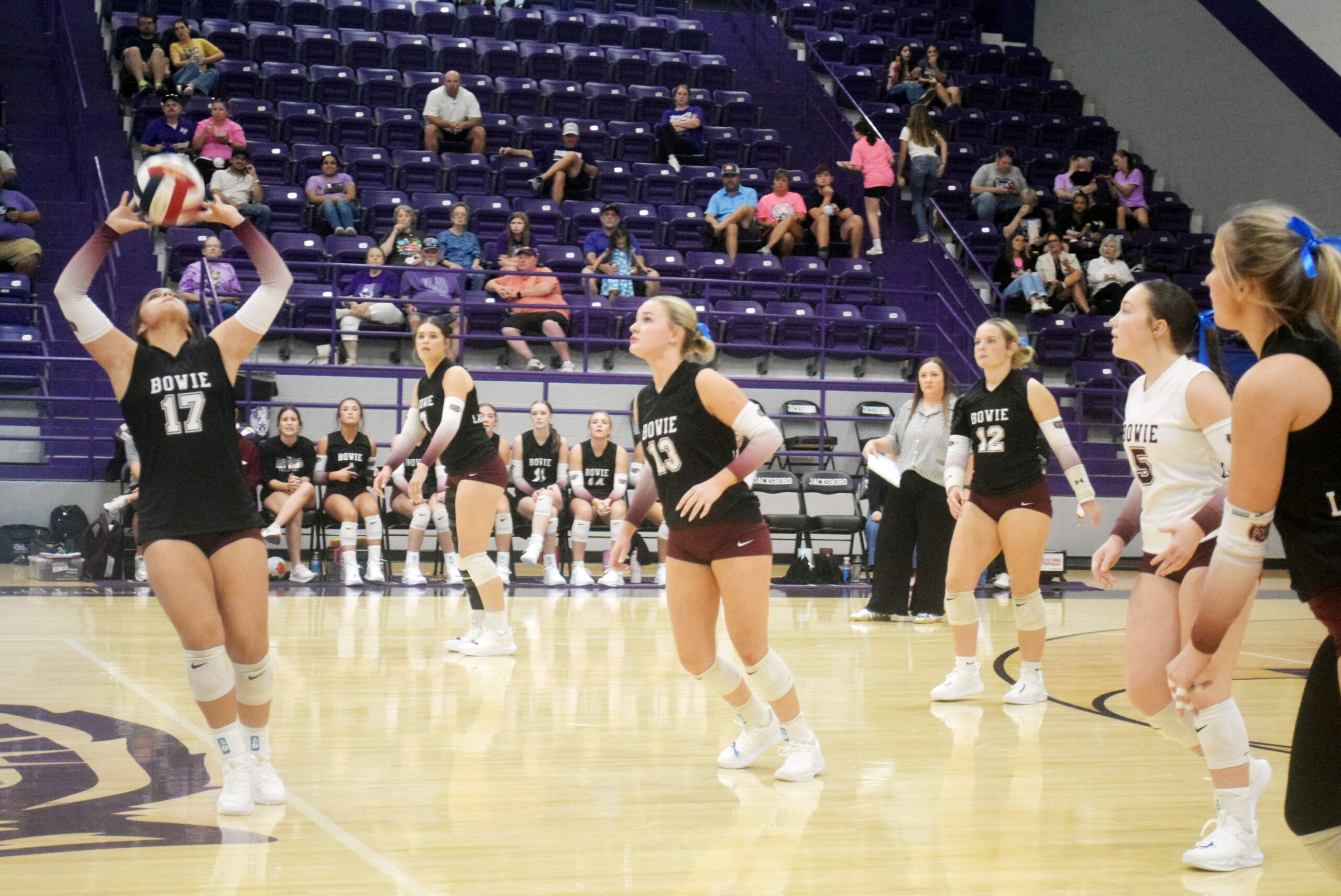
Bowie, playing on a short rest, held with host Jacksboro for most of the volleyball match Oct. 1, but the Tigerettes pulled away late and defeated the Lady Rabbits 3-1 (26-24, 12-25, 25-14, 22-25).
The match was scheduled for Oct. 2 but was moved. Both teams are now 2-2 in District 6-3A.
Jacksboro got out to a quick lead in game one before Olivia Stewart’s kill and a three-point Olivia Richey serving run put the visitors up 8-7. Junior Abby Reneau broke things open with a six-point string to give Bowie a 15-8 cushion and force Jacksboro into a timeout.
The Tigerettes came back and took an 18-16 lead. KP Rutherford’s kill broke the serve and allowed Molly Enlow to tie the game at 18.
For further details, pick up a copy of Thursday’s Bowie News.
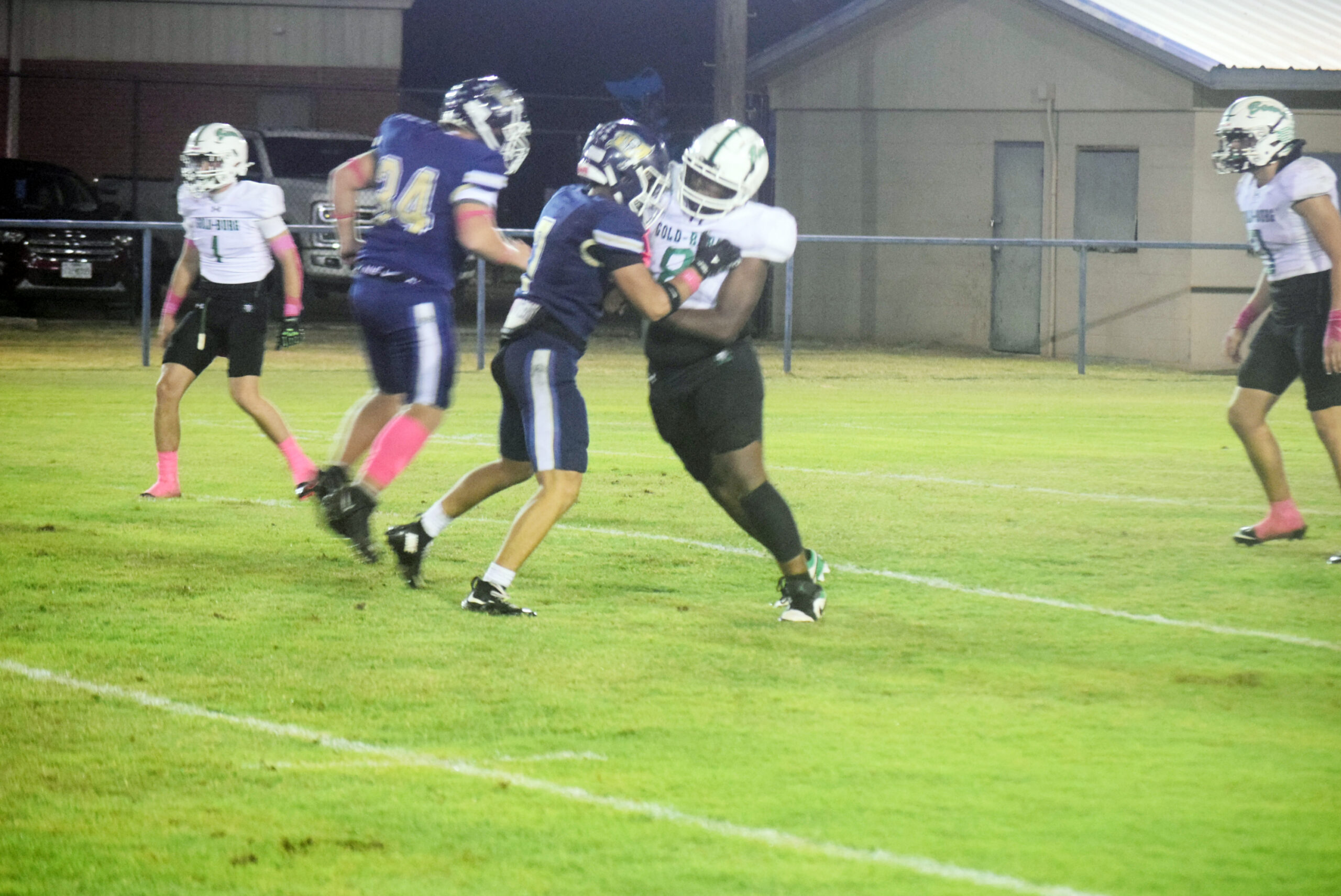
Gold-Burg Football Coach Austin Norman called his Bears’ 35-32 loss to host Perrin a “barn burner”.
It most definitely was as Gold-Burg, now 1-5 for the year gave the 5-1 Pirates everything they wanted for four quarters. Gold-Burg scored on the last play of the first half on a Peyton Epperson run with the two point conversion cutting the deficit to 20-16.
The Bears were their own worst enemy to open the third quarter with face mask and offside penalties moving the Pirates downfield setting up a first-and-goal at the Bear three. Defense by Epperson, Keelyn Case and Barrett Allen and a pair of Perrin penalties helped stop the drive and force a turnover on downs.
Gold-Burg was slapped with an intentional grounding penalty on the first play, giving Perrin a safety and extending the Pirate lead to 22-16. Defense by Epperson and JoJuan Grace after a first down run closed out the third quarter.
For further details, pick up a copy of Thursday’s Bowie News.
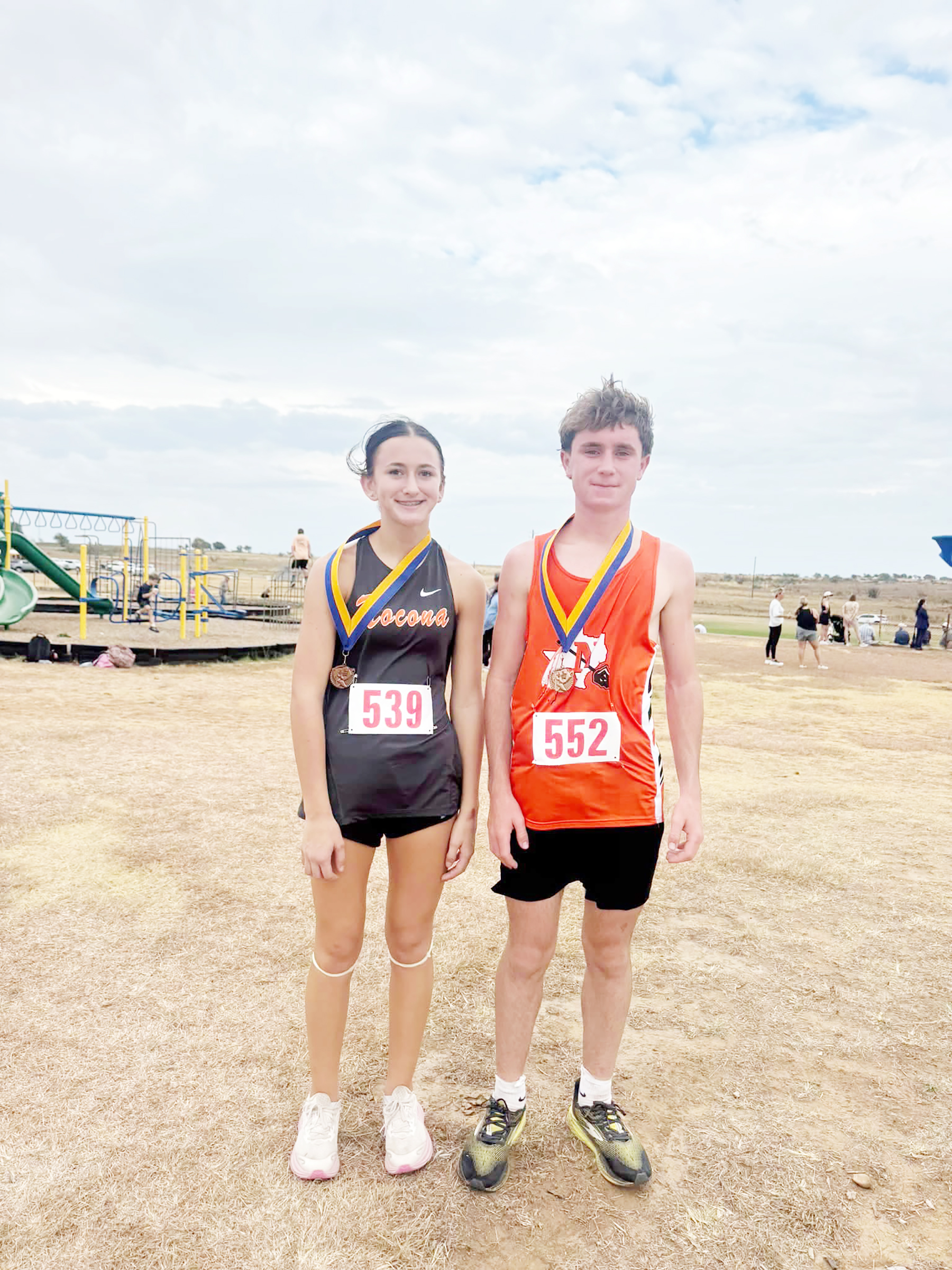
Nocona and Prairie Valley cross country teams took part in the Prairie Valley Invitational Sept. 20 while Bowie varsity runners competed in the Lubbock Invitational.
Lubbock
Leading the Rabbits was Kellen Rater who finished 10th among 162 runners with a time of 17:24.50. Finishing behind Rater was Shawn Willett with a time of 19:33.20. Hayden Sutton ran a 20:27.10 followed by Taven Melton in 20:39.20, Coleman Holloway in 20:53.80 and Jaxon Castro with a time of 21:31.60.
Laney Segura led the Lady Rabbits with a time of 14:41.30. She was followed by Kylee Waldrep in 15:56.80, Bella Lozano in 16:04.80, Angeles Alvarez with a time of 16:15.40, AnDee Miller in 16:23.70 and Isabella Caswell in 16:51 flat.
For further details, pick up a copy of Thursday’s Bowie News.






-

 NEWS3 years ago
Suspect indicted, jailed in Tia Hutson murder
-
 NEWS4 years ago
Wreck takes the life of BHS teen, 16
-
 NEWS4 years ago
2 hurt, 1 jailed after shooting incident north of Nocona
-

 NEWS3 years ago
Murder unsolved – 1 year later Tia Hutson’s family angry, frustrated with no arrest
-
 NEWS3 years ago
SO investigating possible murder/suicide
-
 Show us something good9 years ago
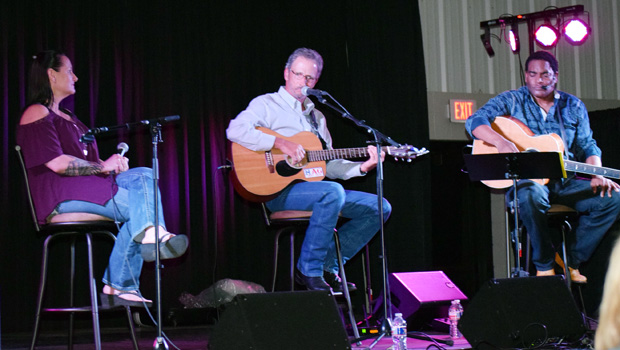
Country music star children perform in Bowie
-
 100th Birthday4 years ago
Looking back at the 1958 Centennial edition of The Bowie News
-
NEWS3 years ago
Sheriff’s office called out to infant’s death