
SPORTS
No powder but plenty of air


By Luke Clayton
It’s been a great week and I’ve been blessed to spend time with fine friends that share my love of the outdoors. For those of us that love to hunt, this is most definitely ‘our’ time of year. The weather is cooling although not quite as quickly as most of us would like, seems like summer has lingered longer than I can remember this fall.
I devoted this week to hunting whitetail here in northeast Texas where I live and oryx in southeastern Oklahoma at the Choctaw Hunting Lodge, more about both those hunts in a bit. Some folks ask why I like to hunt with air rifles, and I usually reply it’s the same reason I like hunting with muzzleloaders, bows and centerfire rifles, it’s something new that I enjoyed learning about and putting to use in the field. Each weapon comes with its own set of challenges, limitations and advantages.
Airforce Airguns came out with the first production big bore air rifle about a decade ago. I was fortunate to test one of the first production models of The Texan, a .45 caliber solidly built rifle that has gained recognition as one of the best hunting rifles powered by compressed air on the market. The company now has a new powerhouse air rifle, the Tex Rex which is 51 caliber that pressures up to 4,500 PSI.
It takes a lot of pressure to push a big 388 grain slug down the barrel and after a bunch of pre hunt shooting, I found it to be a very effective hunting rifle for any game I might be hunting and this including the Oryx, which is a big, heavy bones very tasty antelope.
After spending time at the range with my new rifle topped with an ATN X Sight digital scope, I felt totally comfortable shooting game out to 75 yards. The rifle has taken a lot of deer out to 100 yards and a bit beyond but 75 yards is my self-imposed limitation with an air rifle. Old habits are hard to break. After hunting with the rifle and seeing how effective it is I’m planning to sight it in at 100 yards.
WHITETAIL FIRST I have some great friends, Edgar Cotton and his son David in Kaufman County where I live that own some prime whitetail deer hunting land. Our mutual friend Larry Weishuhn helps them manage the property and it’s currently under a managed lands program where the numbers of doe and bucks that need to be harvested is set each year. My goal was to possibly take one of the mature management bucks with the Tex Rex or possibly a heavy doe for the freezer.
David dropped me off at an elevated blind overlooking a food plot where I had hunted the past couple years. Here I used my CVA 50 caliber Optima last year to take a heavy horned old management buck. On this recent hunt, I was armed with the 51 caliber pressured with air, loaded with a 388-grain hollow point slug.
There was little deer activity until the last thirty minute of legal shooting light then a young eight point eased out onto the field to nibble on the green shoots, obviously wanting a little ‘salad’ to go with the acorns I am sure he had been feeding on. He came out of a heavy stand of oaks that had a bumper crop this year.
The young buck soon moved on and shortly 6 doe eased out of the same stand of oaks. They were on the far side of the field nibbling on the green shoots and it appeared they weren’t going to get far from the cover of the woods.
I settled the crosshairs on a fat doe just as the herd began to feed back toward the cover, the distance was 72 yards. At the report of the air rifle, which by the way not quite like most people think. A blast of air pressured to 4,500 does produce a notable report. I heard the thump of the bullet and felt confident with the shot. I watched the doe disappear into the heaviest cover and as most hunters do, I began to doubt my shot.
I found no obvious sign of a hit but scoured the nearby woods for the deer. I simply could not find it in the heavy cover. This called for more boots on the ground and our friend William Nixon walked upon the deer in some very dense brush surrounded by broom sedge. The deer went about 65 yards, I’ve tracked many deer shot with centerfires that far and farther.
ON TO ORYX I’ve always been fascinated by Scimitar-horned Oryx and recently had the chance to hunt them. I wasn’t successful in my short hunt at the Choctaw Lodge in southeast Oklahoma owned by the Choctaw Nation and managed by Dusty Vickrey and his wife Nacolh but I plan to return soon and give it another try. These big antelope were once endangered but now their numbers are high thanks to good management here in the US They have even been reintroduced to their native land in north Africa.
My hunt was for a non-trophy oryx, one with either a broken horn or possibly one with a horn that had been damaged. There were several such animals in the herd. I was hunting a feeder situated in some relatively open woods on the side of a hill. Oryx were not patterned to hit the feeder early morning and later afternoon like deer, they are subject to show up anytime throughout the day.
My friend Larry Weishuhn and I settled in before daylight and set until mid-morning watching whitetail deer and turkey but never a sigh of those big, beautiful antelope with long spiral horns. Dusty arrived and asked if we wanted to do a bit of still hunting and hopefully slip up within shooting range. We were all in but soon found there are easier things to do than get close to a wary herd of oryx.
We did locate a herd of about ten animals. One lone oryx might not be so hard to hunt but ten noses and twenty eyeballs from these warm animals made it difficult to get an ethical shot. We were hunting specific animals and they always managed to be either in the middle of the herd or be in front of another animal. I had commitments at home and had to leave after the mid-day hunt, vowing to return at the next opportunity for another attempt to fulfill a long-time dream.
FINE DINING Nacolh is an excellent cook, one of the best I know, and she has what I kidding call her ‘signature dish’. She makes a hamburger steak from ground meat with gravy that is delectable. This time she used ground oryx to prepare the dish and words are insufficient to describe just how tasty it was.
Oryx meat is absolutely better than the finest beef I’ve eaten and even better than bison which I used to consider one of the most flavorful of all. Now I am really focused on taking an oryx, can’t wait until I again make my way to that beautiful mountain country of southeast Oklahoma. By the way, Dusty makes a mighty fine pot of stewed turnips, but that is an entirely different story.
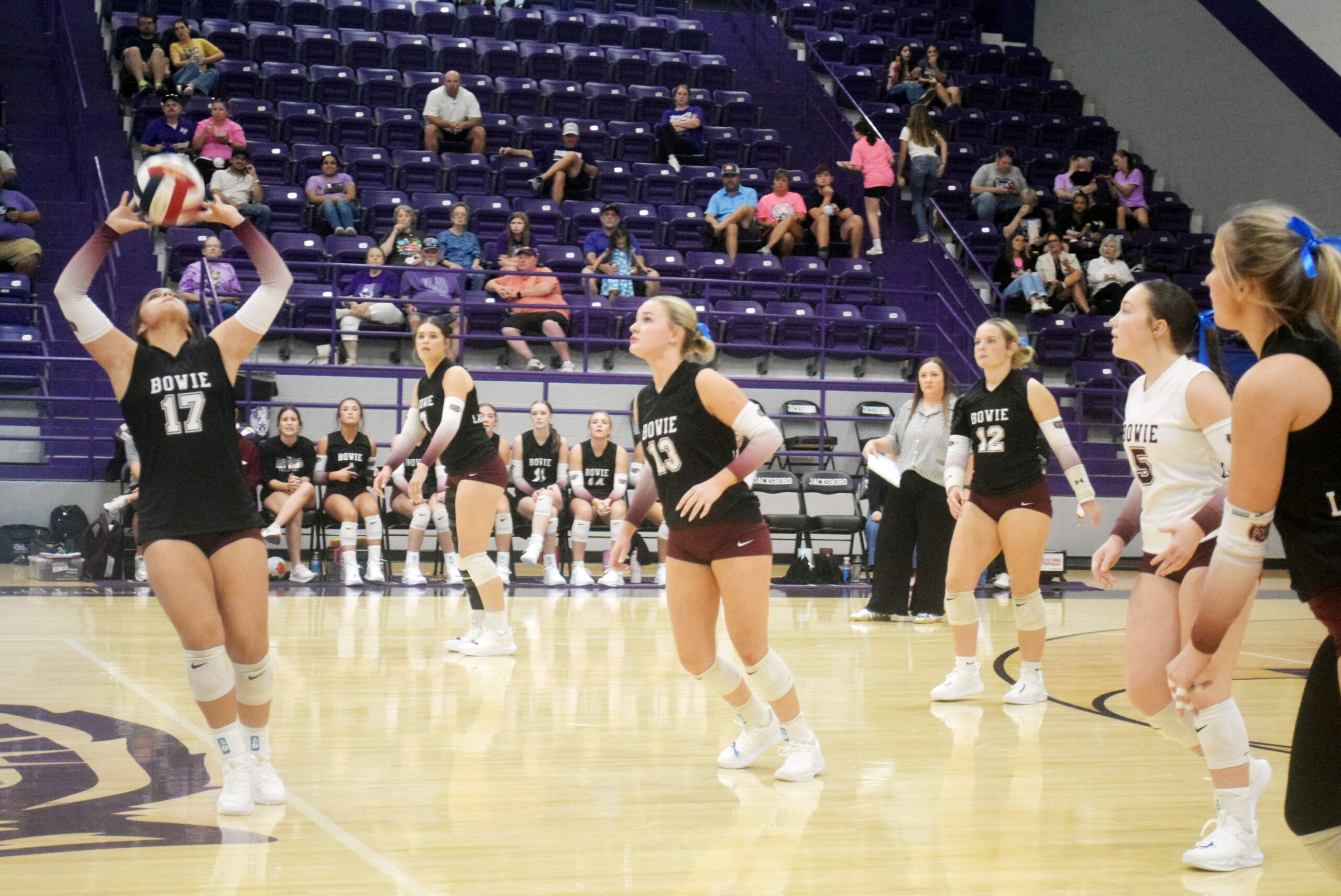
Bowie, playing on a short rest, held with host Jacksboro for most of the volleyball match Oct. 1, but the Tigerettes pulled away late and defeated the Lady Rabbits 3-1 (26-24, 12-25, 25-14, 22-25).
The match was scheduled for Oct. 2 but was moved. Both teams are now 2-2 in District 6-3A.
Jacksboro got out to a quick lead in game one before Olivia Stewart’s kill and a three-point Olivia Richey serving run put the visitors up 8-7. Junior Abby Reneau broke things open with a six-point string to give Bowie a 15-8 cushion and force Jacksboro into a timeout.
The Tigerettes came back and took an 18-16 lead. KP Rutherford’s kill broke the serve and allowed Molly Enlow to tie the game at 18.
For further details, pick up a copy of Thursday’s Bowie News.
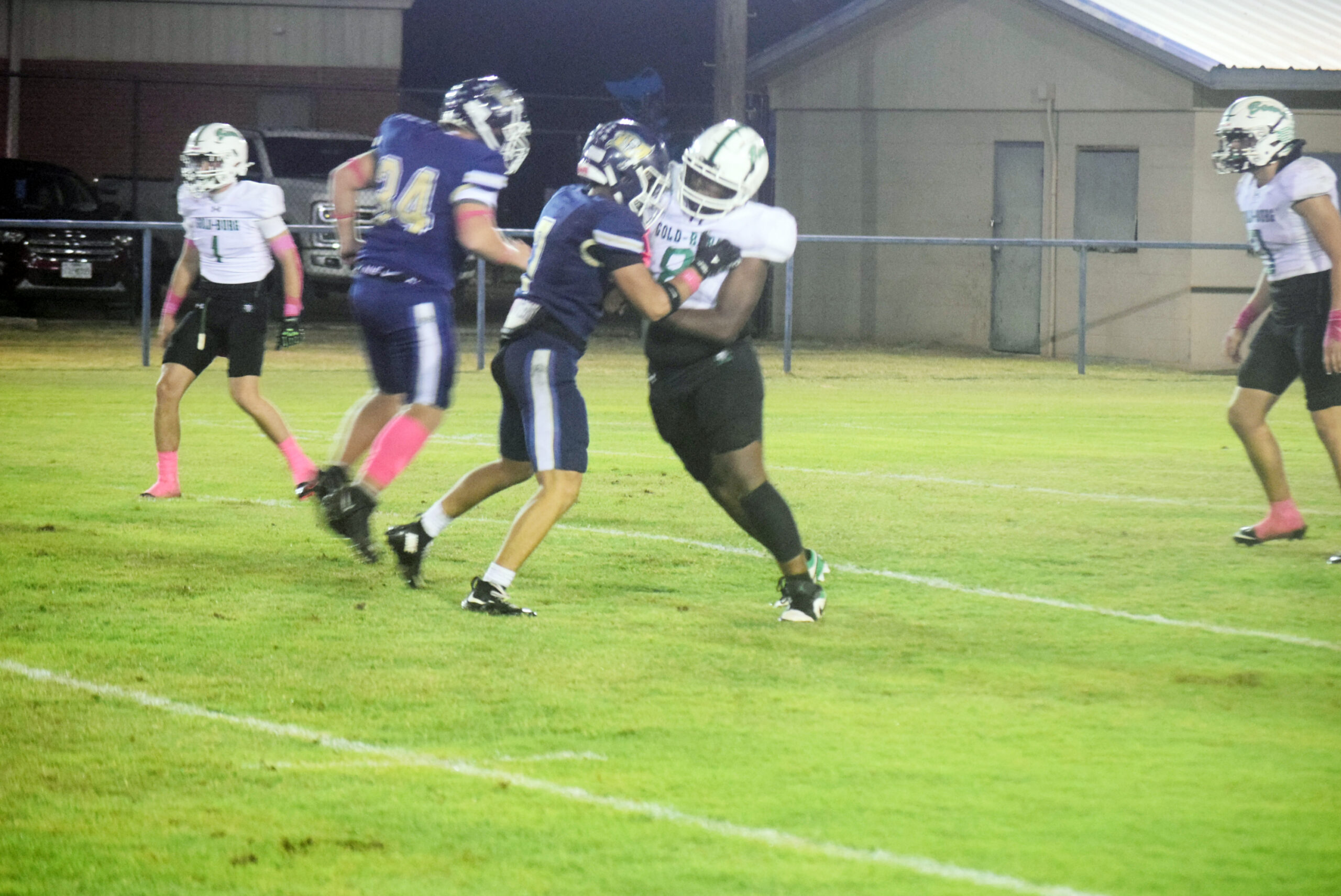
Gold-Burg Football Coach Austin Norman called his Bears’ 35-32 loss to host Perrin a “barn burner”.
It most definitely was as Gold-Burg, now 1-5 for the year gave the 5-1 Pirates everything they wanted for four quarters. Gold-Burg scored on the last play of the first half on a Peyton Epperson run with the two point conversion cutting the deficit to 20-16.
The Bears were their own worst enemy to open the third quarter with face mask and offside penalties moving the Pirates downfield setting up a first-and-goal at the Bear three. Defense by Epperson, Keelyn Case and Barrett Allen and a pair of Perrin penalties helped stop the drive and force a turnover on downs.
Gold-Burg was slapped with an intentional grounding penalty on the first play, giving Perrin a safety and extending the Pirate lead to 22-16. Defense by Epperson and JoJuan Grace after a first down run closed out the third quarter.
For further details, pick up a copy of Thursday’s Bowie News.

Nocona and Prairie Valley cross country teams took part in the Prairie Valley Invitational Sept. 20 while Bowie varsity runners competed in the Lubbock Invitational.
Lubbock
Leading the Rabbits was Kellen Rater who finished 10th among 162 runners with a time of 17:24.50. Finishing behind Rater was Shawn Willett with a time of 19:33.20. Hayden Sutton ran a 20:27.10 followed by Taven Melton in 20:39.20, Coleman Holloway in 20:53.80 and Jaxon Castro with a time of 21:31.60.
Laney Segura led the Lady Rabbits with a time of 14:41.30. She was followed by Kylee Waldrep in 15:56.80, Bella Lozano in 16:04.80, Angeles Alvarez with a time of 16:15.40, AnDee Miller in 16:23.70 and Isabella Caswell in 16:51 flat.
For further details, pick up a copy of Thursday’s Bowie News.






-

 NEWS3 years ago
Suspect indicted, jailed in Tia Hutson murder
-

 NEWS4 years ago
Wreck takes the life of BHS teen, 16
-
 NEWS4 years ago
2 hurt, 1 jailed after shooting incident north of Nocona
-

 NEWS3 years ago
Murder unsolved – 1 year later Tia Hutson’s family angry, frustrated with no arrest
-
 NEWS3 years ago
SO investigating possible murder/suicide
-
 Show us something good9 years ago
Country music star children perform in Bowie
-
 100th Birthday4 years ago
Looking back at the 1958 Centennial edition of The Bowie News
-
NEWS3 years ago
Sheriff’s office called out to infant’s death