
SPORTS
ShareLunker program begins Jan. 1


ATHENS – New Year’s Day 2026 will launch the 40th season of the Toyota ShareLunker Program, another major milestone for Texas’ highly acclaimed and storied largemouth bass selective breeding and stocking program.
Since 1986, anglers from throughout the state and nation have gone fishing on Texas lakes and cast their lines in hopes of landing a Legacy Class largemouth bass weighing 13 pounds or more.
During the first three months of each Toyota ShareLunker season (Jan. 1 through March 31), anglers who reel in a Legacy Class largemouth bass have the option of loaning it to Texas Parks and Wildlife Department (TPWD) for captive spawning at the Texas Freshwater Fisheries Center in Athens. Its offspring will then be reared and stocked back into public lakes throughout the state, continuing to build and sustain the legacy of bigger, better bass for current and future generations of Texas anglers.
The Toyota ShareLunker Program plays an integral role in building and maintaining quality bass fisheries for the millions of freshwater anglers who go fishing on the state’s lakes and rivers each year. Grabbing a pole, hitting the water, and hauling in a 13-pound largemouth bass would be a great way to kick off the new year. The cast of the line, the lure landing just right on the water, and a strike from a possible fish of a lifetime is what many anglers strive to experience.
“For 40 years, the Toyota ShareLunker Program has partnered with anglers to grow bigger, better bass and elevate Texas into a world-class fishing destination” said Natalie Goldstrohm, Toyota ShareLunker Program Coordinator. “Every Legacy Class fish shared with TPWD helps advance selective breeding and stocking efforts that benefit bass fisheries statewide. This milestone season is a celebration of the participating anglers, TPWD Inland Fisheries Division employees, our partners and sponsors, and the collaborative fisheries conservation efforts that make these incredible catches possible.”
The Toyota ShareLunker Program had a banner season in 2025. Key highlights included:
- Nine public lakes delivered Legacy Class Lunkers, consisting of O.H. Ivie, Richland-Chambers, Lady Bird, J.B. Thomas, Alan Henry, Tawakoni, Sam Rayburn, Tyler and Toledo Bend. The catch of a Legacy Class Lunker at Lake Tawakoni increased the number of public lakes that have produced Legacy Class ShareLunker entries to a total of 79.
- Lake O.H. Ivie in West Texas was at the head of the class again this season with six Legacy Class entries.
- Angler Willie Pipkin set a new lake record on Feb. 5 with his 14.05-pound bass caught at Lady Bird Lake.
- Four anglers caught their second Legacy Class Lunker, consisting of Brady Stanford, Ross Gomez, Terry Scott, and Mechelda Criswell.
- Angler Ross Gomez caught the same Legacy Class Lunker twice two years apart, a first for the program.
- Lakes Tyler and Sam Rayburn combined for a double-lunker day on March 22.
Anglers who catch a qualifying fish can call the ShareLunker hotline at (903) 681-0550 to report their catch 24/7 through March 31, 2026.
Anglers that catch and loan a 13-plus pound lunker earn Legacy Class status, receive a catch kit filled with merchandise donated by program sponsors, a 13lb+ Legacy decal for their vehicle or boat, VIP access to the Toyota ShareLunker Annual Awards event, a high-quality replica mount of their fish from Lake Fork Taxidermy, ShareLunker branded apparel provided by AFTCO, and Bass University will provide a swag pack and annual subscription. Anglers also receive entries into two separate drawings – a Legacy Class Drawing and the year-end Grand Prize Drawing. Both drawings will award the winner a $5,000 Bass Pro Shops shopping spree.
The year-round Toyota ShareLunker Program offers anglers three additional levels of participation for catching bass over eight pounds or 24 inches in Texas public waters. Each of these levels provide vital data to TPWD fisheries biologists, helping them continue to create bigger, better bass in Texas.
Anglers who enter data for any lunker they catch greater than eight pounds or 24 inches also receive a catch kit, a decal for their vehicle or boat, a one-month subscription to Bass University and an entry into the year-end Grand Prize Drawing to win a $5,000 Bass Pro Shops shopping spree. ShareLunker entry classes include the Bass Pro Shops Lunker Class (8 lb.+), Strike King Elite Class (10 lb.+) and Lew’s Legend Class (13 lb.+).
Once a qualified lunker is reeled in, anglers need to enter the catch data on the Toyota ShareLunker mobile app – available for free from the Apple App Store and Google Play – or at TexasSharelunker.com.
In addition to providing basic catch information, anglers have the option to send a DNA scale sample from their lunker bass to TPWD researchers for genetic analysis. Anglers who contribute a sample to the program will receive a Lew’s reel while supplies last, with a limit of one reel per angler. Anglers who send in a genetic sample will also get a three-month subscription to Bass University. Instructions for submitting DNA samples are located on the Toyota ShareLunker website.
TPWD and the Toyota ShareLunker Program are once again partnering with AFTCO on the AFTCO Guide of the Year award for the 2026 ShareLunker season. The AFTCO Guide of the Year award recognizes a fishing guide who contributes to conservation and enhancement of largemouth bass in Texas.
The Toyota ShareLunker Program is made possible in part by the generous title sponsorship of Toyota. Toyota is a longtime supporter of the Texas Parks and Wildlife Foundation and TPWD, providing major funding for a wide variety of fisheries, state parks and wildlife projects.
Additional vital program support comes from Legend Class category prize sponsor Lew’s, Elite class category prize sponsor Strike King, Lunker class category prize sponsor Bass Pro Shops, AFTCO, Bass Forecast, Bass University and Lake Fork Taxidermy. For updates on the Toyota ShareLunker Program, visit facebook.com/sharelunkerprogram/, https://www.instagram.com/TexasShareLunker/ or TexasSharelunker.com.
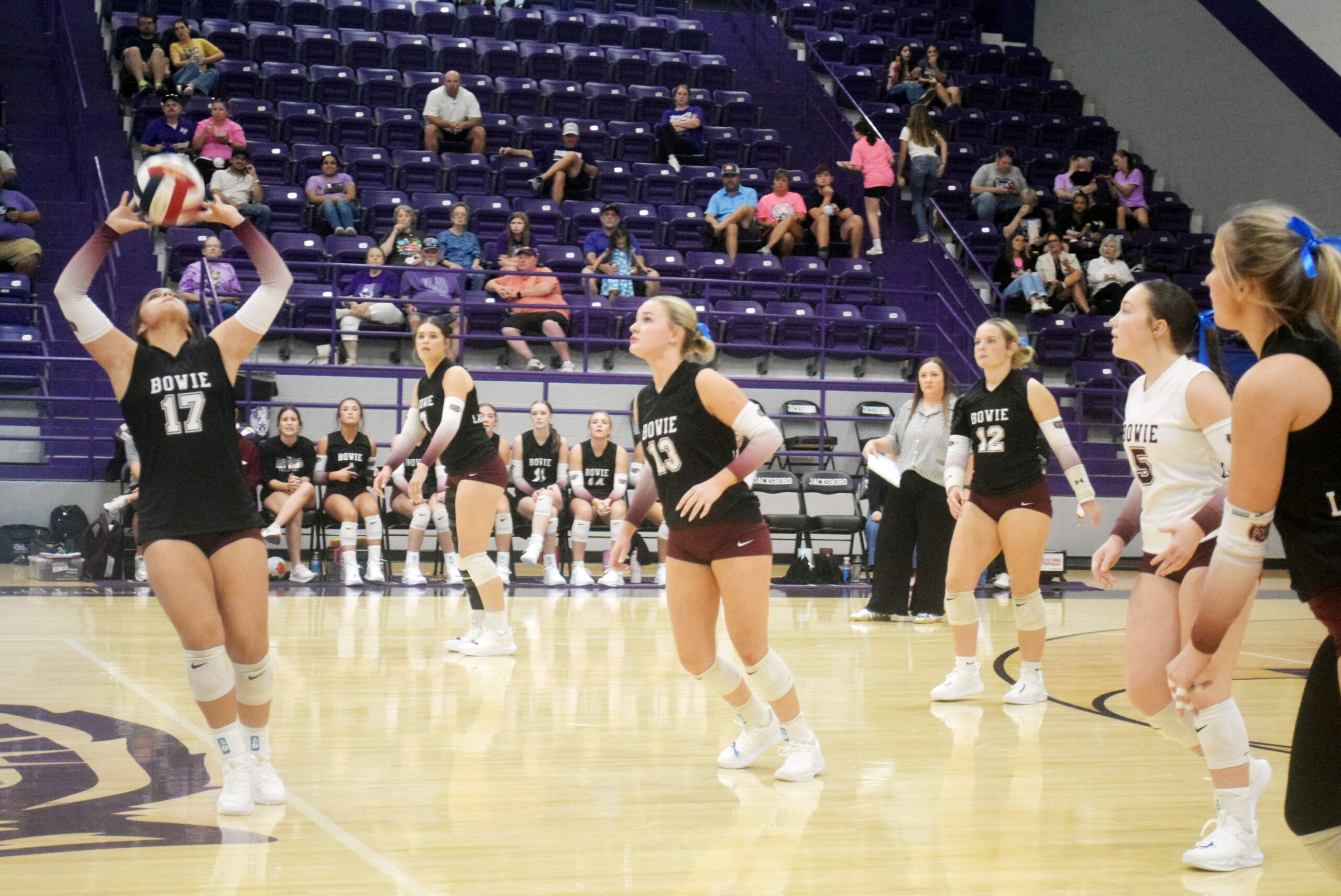
Bowie, playing on a short rest, held with host Jacksboro for most of the volleyball match Oct. 1, but the Tigerettes pulled away late and defeated the Lady Rabbits 3-1 (26-24, 12-25, 25-14, 22-25).
The match was scheduled for Oct. 2 but was moved. Both teams are now 2-2 in District 6-3A.
Jacksboro got out to a quick lead in game one before Olivia Stewart’s kill and a three-point Olivia Richey serving run put the visitors up 8-7. Junior Abby Reneau broke things open with a six-point string to give Bowie a 15-8 cushion and force Jacksboro into a timeout.
The Tigerettes came back and took an 18-16 lead. KP Rutherford’s kill broke the serve and allowed Molly Enlow to tie the game at 18.
For further details, pick up a copy of Thursday’s Bowie News.
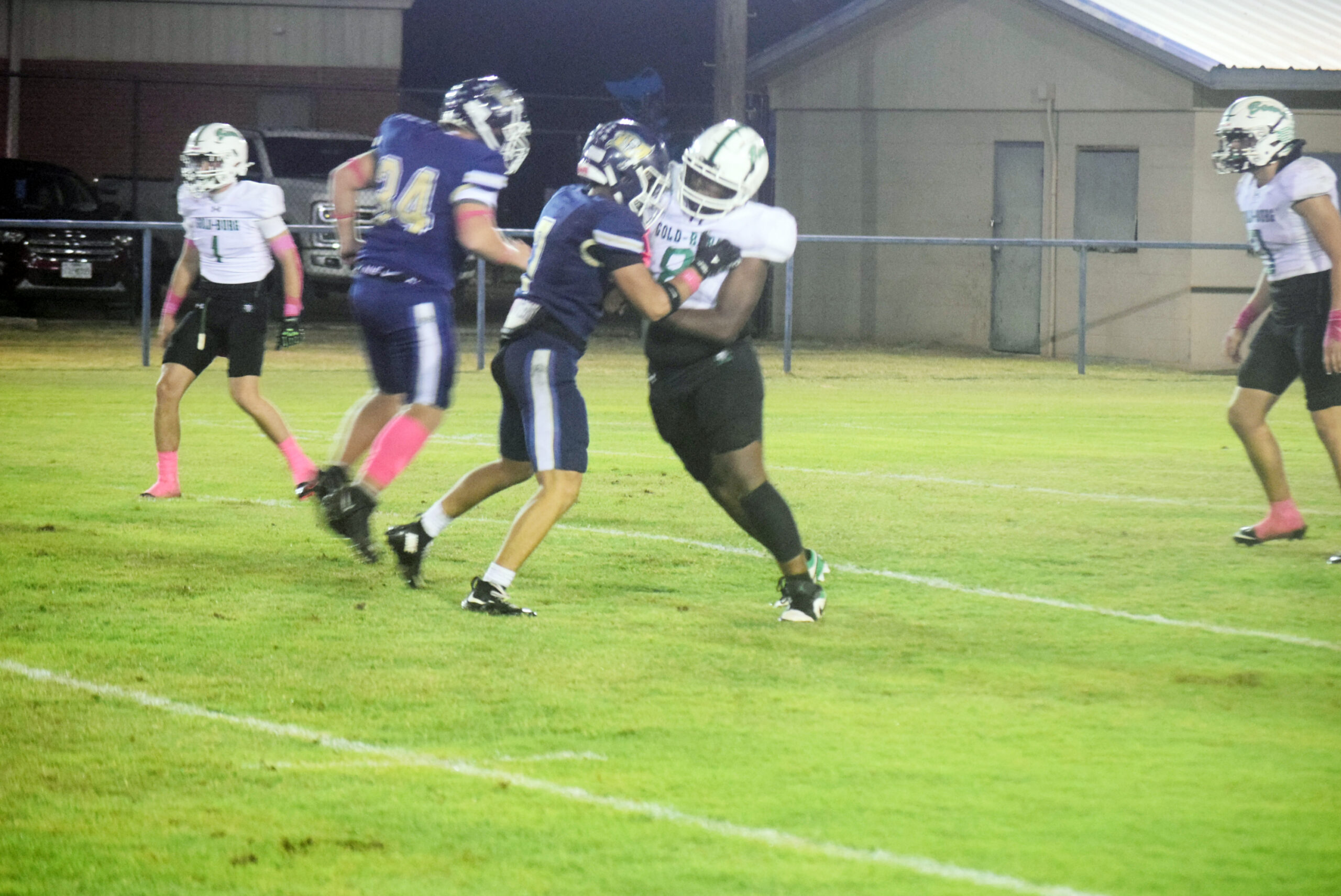
Gold-Burg Football Coach Austin Norman called his Bears’ 35-32 loss to host Perrin a “barn burner”.
It most definitely was as Gold-Burg, now 1-5 for the year gave the 5-1 Pirates everything they wanted for four quarters. Gold-Burg scored on the last play of the first half on a Peyton Epperson run with the two point conversion cutting the deficit to 20-16.
The Bears were their own worst enemy to open the third quarter with face mask and offside penalties moving the Pirates downfield setting up a first-and-goal at the Bear three. Defense by Epperson, Keelyn Case and Barrett Allen and a pair of Perrin penalties helped stop the drive and force a turnover on downs.
Gold-Burg was slapped with an intentional grounding penalty on the first play, giving Perrin a safety and extending the Pirate lead to 22-16. Defense by Epperson and JoJuan Grace after a first down run closed out the third quarter.
For further details, pick up a copy of Thursday’s Bowie News.
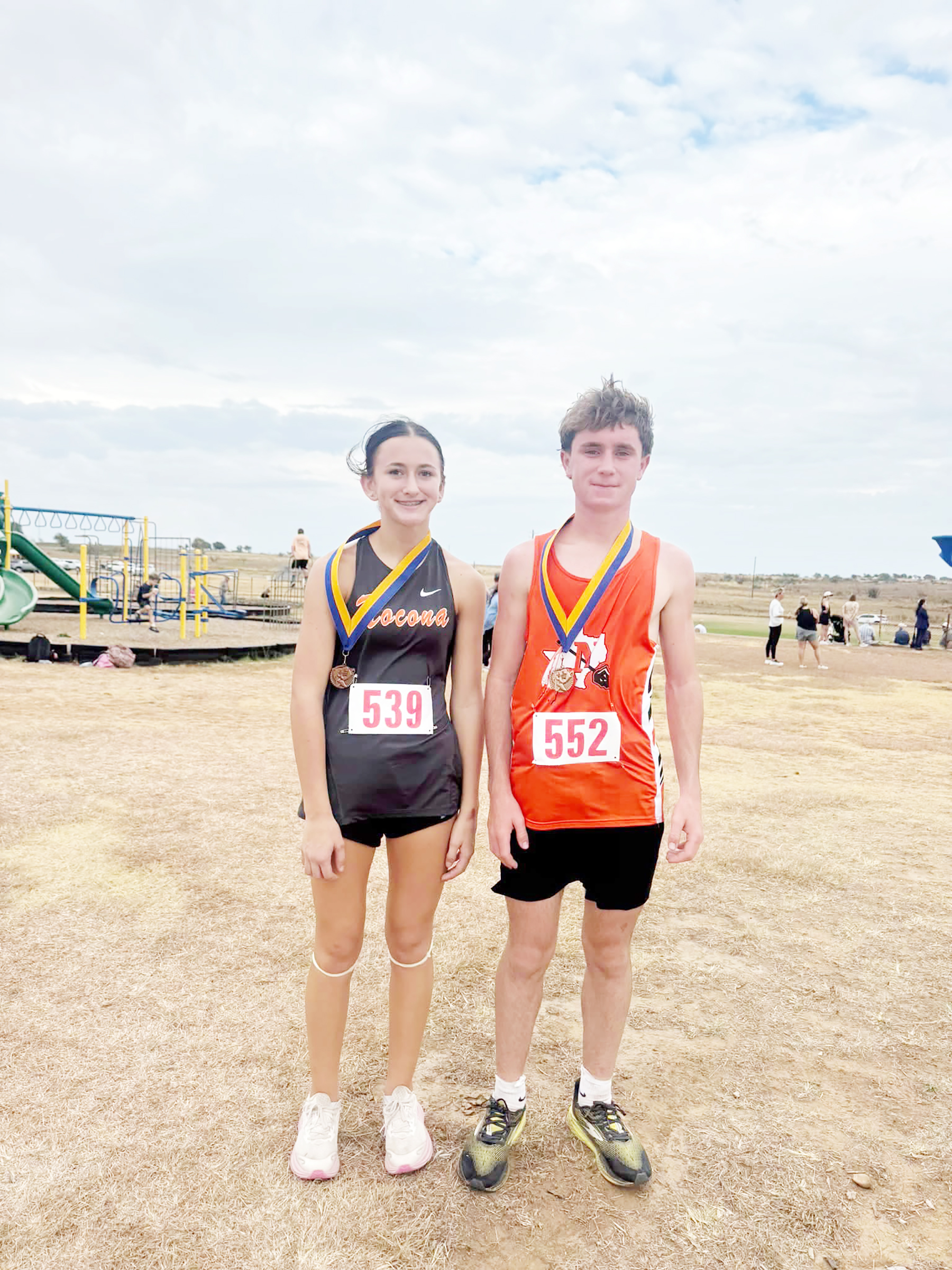
Nocona and Prairie Valley cross country teams took part in the Prairie Valley Invitational Sept. 20 while Bowie varsity runners competed in the Lubbock Invitational.
Lubbock
Leading the Rabbits was Kellen Rater who finished 10th among 162 runners with a time of 17:24.50. Finishing behind Rater was Shawn Willett with a time of 19:33.20. Hayden Sutton ran a 20:27.10 followed by Taven Melton in 20:39.20, Coleman Holloway in 20:53.80 and Jaxon Castro with a time of 21:31.60.
Laney Segura led the Lady Rabbits with a time of 14:41.30. She was followed by Kylee Waldrep in 15:56.80, Bella Lozano in 16:04.80, Angeles Alvarez with a time of 16:15.40, AnDee Miller in 16:23.70 and Isabella Caswell in 16:51 flat.
For further details, pick up a copy of Thursday’s Bowie News.






-

 NEWS3 years ago
Suspect indicted, jailed in Tia Hutson murder
-

 NEWS4 years ago
Wreck takes the life of BHS teen, 16
-
 NEWS4 years ago
2 hurt, 1 jailed after shooting incident north of Nocona
-

 NEWS3 years ago
Murder unsolved – 1 year later Tia Hutson’s family angry, frustrated with no arrest
-
 NEWS3 years ago
SO investigating possible murder/suicide
-
 Show us something good9 years ago
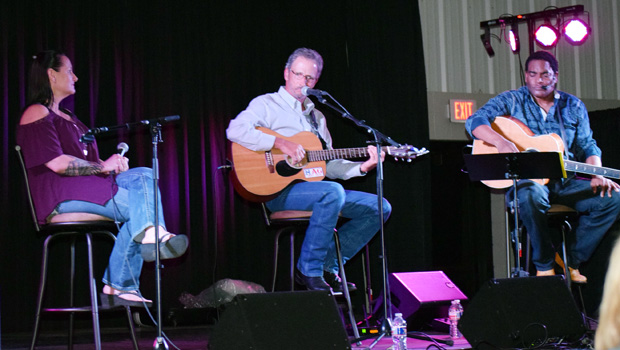
Country music star children perform in Bowie
-
 100th Birthday4 years ago
Looking back at the 1958 Centennial edition of The Bowie News
-
NEWS3 years ago
Sheriff’s office called out to infant’s death