
SPORTS
Lady Indians fall in the bi-district to Windthorst

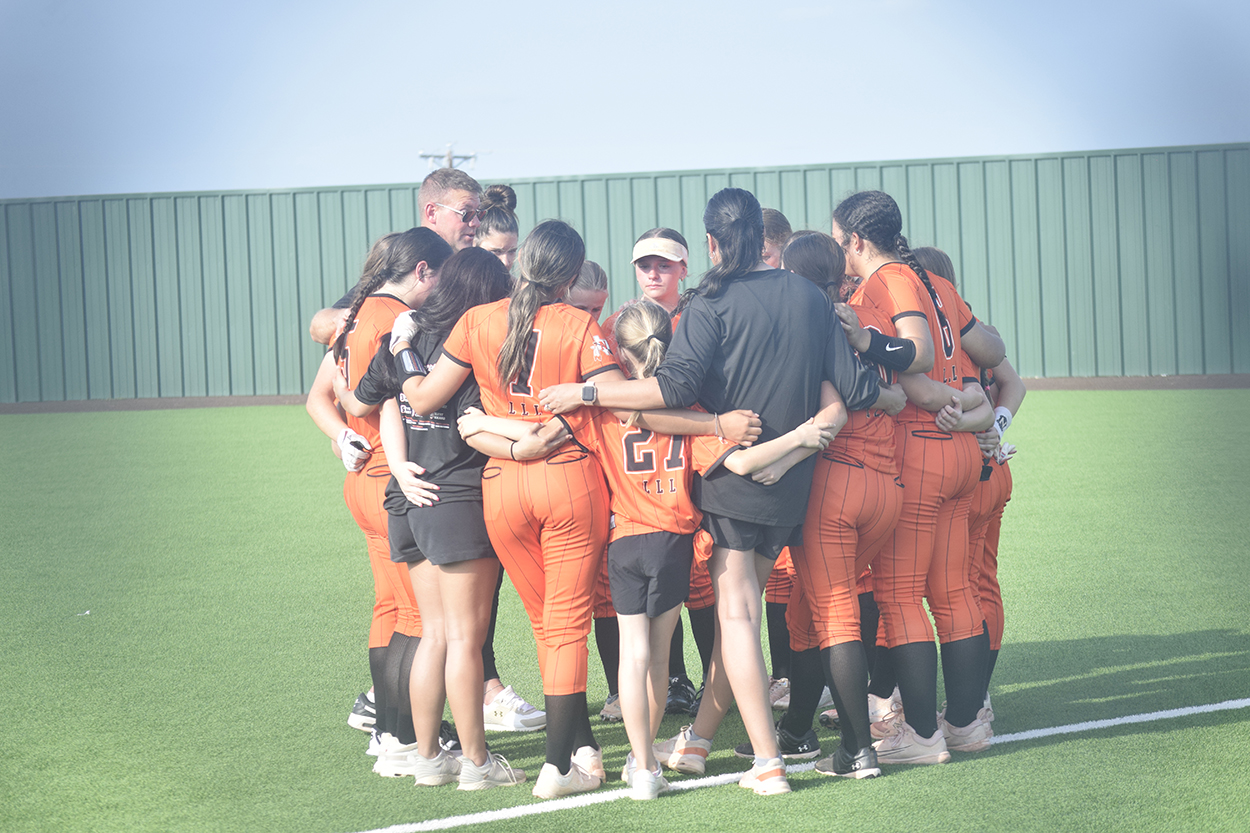
The Nocona Lady Indians trip to the playoffs ended on Friday after losing their bi-district series to Windthorst.
The Lady Trojans won 9-1 and 10-4 against the Lady Indians as they played a series at Wichita Falls Legacy High School.
Nocona came into the series basking in the light of making the playoffs for the first time since 2008, but was also hoping the journey would not end despite entering uncharted waters. The Lady Indians had not just scraped into the postseason though, finishing third overall in the district.
Windthorst came into the postseason having only lost two one-run games against Petrolia in its district and had playoff experience on its side.
Game one started with both teams getting out of early inning jams until the Lady Trojans struck first in the third inning.
Windthorst got on board with an RBI single to take the lead and never looked back.
In the fourth inning, the Lady Trojans added four runs on a solo home run, two RBI double and an RBI triple to go up 5-0. In the fifth inning Windthorst scored four more runs, scoring on a walk with the bases loaded and a three RBI double.
Nocona got on the board in the bottom of the fifth inning. Kaitlyn Tiffner led off with a walk, stole second and third base before later scoring on a wild pitch to cut the lead to 9-1.
Unfortunately, the Lady Indians could not get any more runs across the board even while its defense recovered to shut down the Lady Trojans in the last two innings.
Windthorst won game one 9-1.
Nocona bats were not able to get any hits during the game, though the Lady Indians drew six walks.
Unfortunately, that was not good enough to keep up with the loud bats of the Lady Trojans, who finished with 14 hits. Nocona’s defense committed no fielding errors.
The Lady Indians needed their bats to come alive and started game two on the right note.
After drawing two walks to start the game, Skye Kirby drove one run in with a double. After another drawn walk with the bases loaded, Ma’leigha Franklin was then hit by a pitch to drive in another run as Nocona went up 2-0.
Unfortunately, the Lady Indians could not get any more runs across with the bases loaded and one out. The next two batters struck out to end the scoring chance.
Nocona added to its lead in the second inning. A leadoff walk later led to Kirby driving that base runner in with a line drive single as the Lady Indians were up 3-0. Unfortunately, the streaky offense of Windthorst came alive in the bottom of the second inning.
The Lady Trojans loaded the bases before a single drove in one run, two walks drove in two runs and two fielding errors allowed three more runs. Windthorst took the lead 6-3 and most importantly the momentum.
In the third inning, the Lady Trojans leadoff batter got on third base thanks to an error in the outfield. A sacrifice fly ball drove in the run to improve Windthorst’s lead to 7-3.
The fourth inning saw the Lady Trojans score one run again, this time on an RBI single to make the score 8-3.
In the fifth inning, back-to-back RBI doubles from Windthorst improve its lead to 10-3 heading into the final two innings.
After a scoreless sixth inning, Nocona needed to reel off seven runs to try and save its season entering the seventh inning.
The Lady Indians started with back-to-back singles to get on. Both runners advanced to second and third base following a groundout. A wild pitch allowed one run to score and the other to get on third base. A walk put runners at the corners with only one out.
Unfortunately, the end came in the next at-bat. A line drive was impressively caught by Windthorst’s first basemen who then was able to quickly tag the runner trying to get back on base out for the game and series ending double-play.
Windthorst won 10-4.
Kirby led the team with two RBIs and two hits while Franklin also drive in one run. The team finished with five hits and drew six walks.
Defensively, Nocona’s six errors resulted five runs coming unearned though the Lady Trojans ended up with eight hits and five earned runs.
To read the full story, pick up a copy of the weekly edition of the Bowie News.
For more pictures from game two in the series, click here https://www.dotphoto.com/go.asp?l=bnews1&AID=6874730&T=1
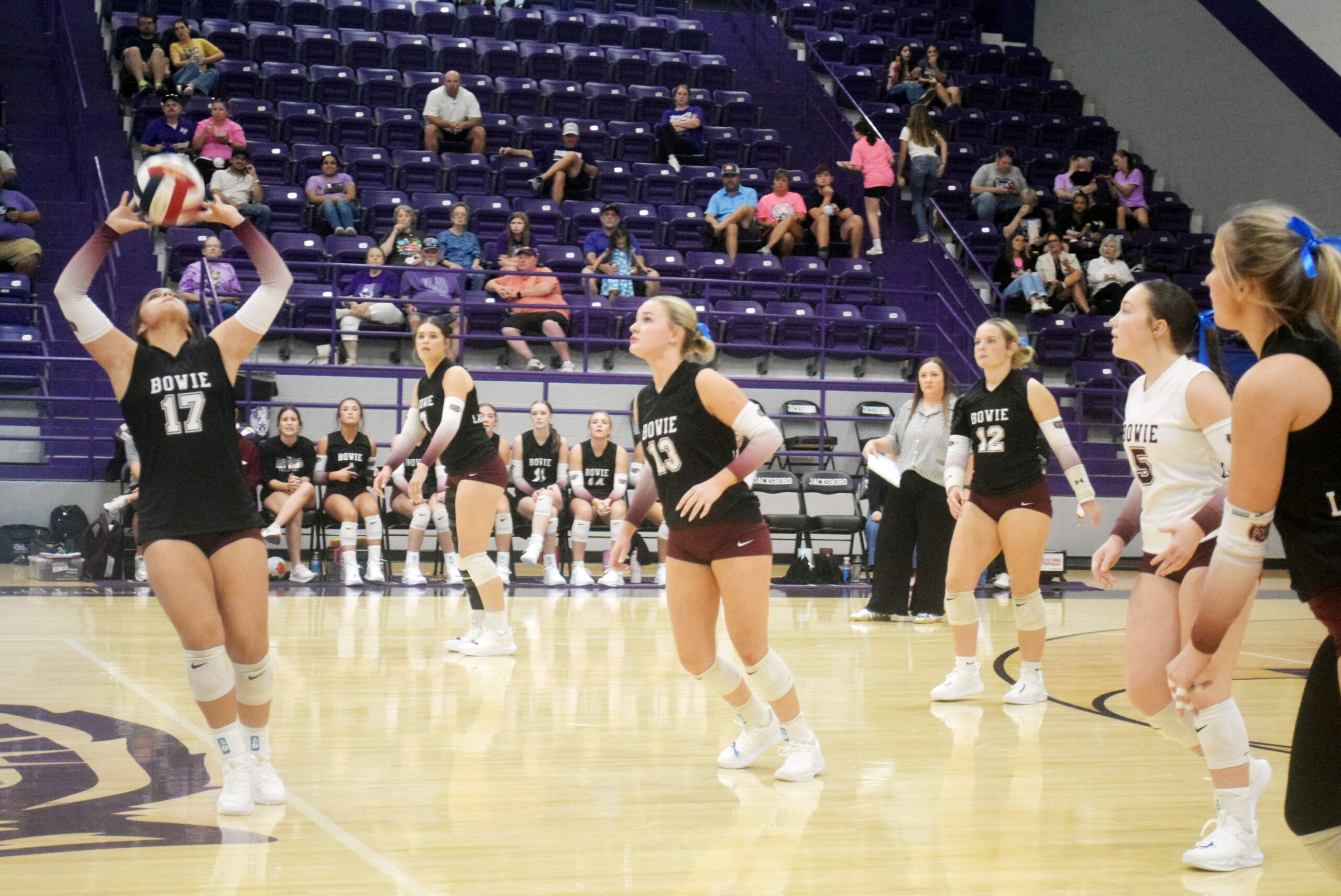
Bowie, playing on a short rest, held with host Jacksboro for most of the volleyball match Oct. 1, but the Tigerettes pulled away late and defeated the Lady Rabbits 3-1 (26-24, 12-25, 25-14, 22-25).
The match was scheduled for Oct. 2 but was moved. Both teams are now 2-2 in District 6-3A.
Jacksboro got out to a quick lead in game one before Olivia Stewart’s kill and a three-point Olivia Richey serving run put the visitors up 8-7. Junior Abby Reneau broke things open with a six-point string to give Bowie a 15-8 cushion and force Jacksboro into a timeout.
The Tigerettes came back and took an 18-16 lead. KP Rutherford’s kill broke the serve and allowed Molly Enlow to tie the game at 18.
For further details, pick up a copy of Thursday’s Bowie News.
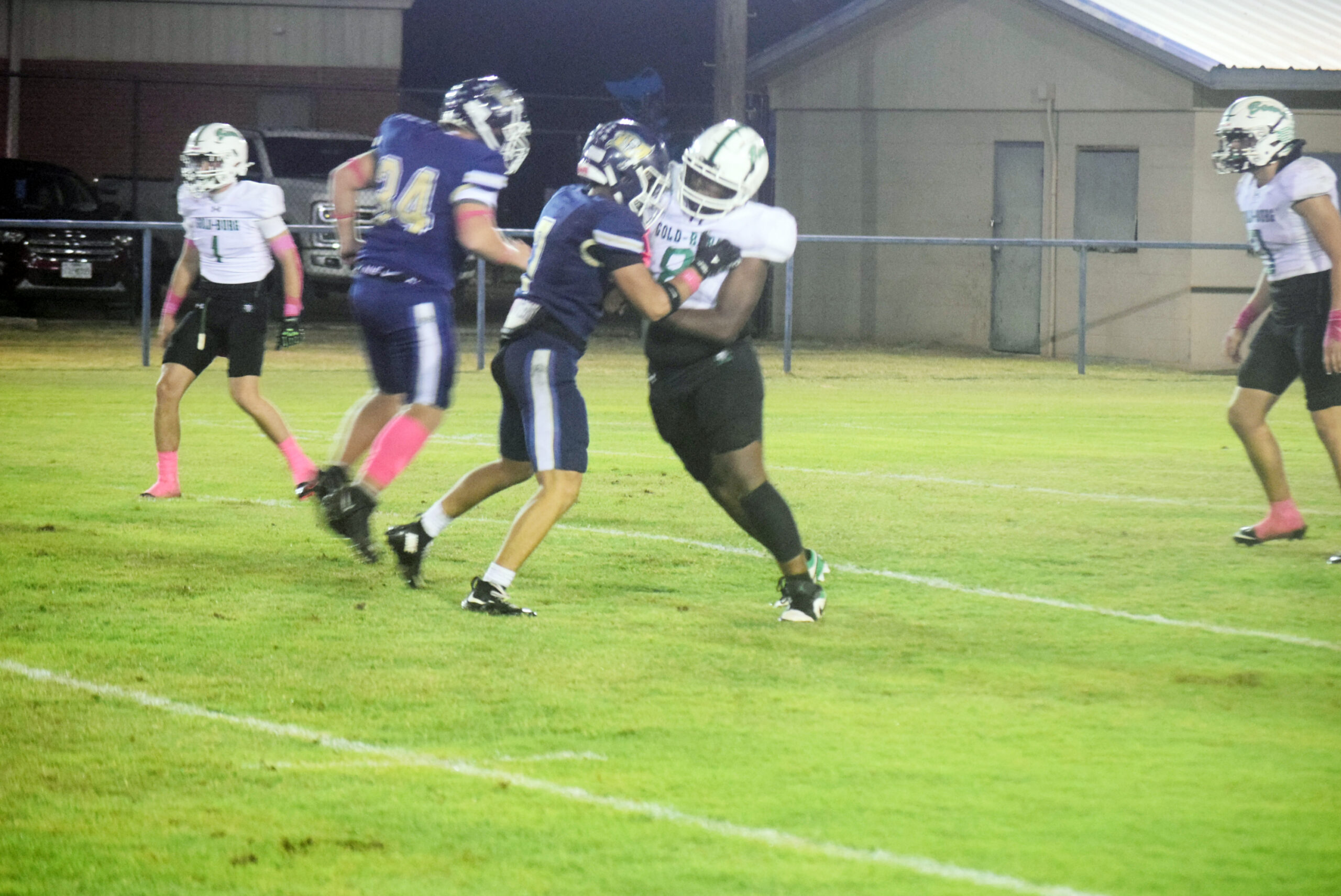
Gold-Burg Football Coach Austin Norman called his Bears’ 35-32 loss to host Perrin a “barn burner”.
It most definitely was as Gold-Burg, now 1-5 for the year gave the 5-1 Pirates everything they wanted for four quarters. Gold-Burg scored on the last play of the first half on a Peyton Epperson run with the two point conversion cutting the deficit to 20-16.
The Bears were their own worst enemy to open the third quarter with face mask and offside penalties moving the Pirates downfield setting up a first-and-goal at the Bear three. Defense by Epperson, Keelyn Case and Barrett Allen and a pair of Perrin penalties helped stop the drive and force a turnover on downs.
Gold-Burg was slapped with an intentional grounding penalty on the first play, giving Perrin a safety and extending the Pirate lead to 22-16. Defense by Epperson and JoJuan Grace after a first down run closed out the third quarter.
For further details, pick up a copy of Thursday’s Bowie News.
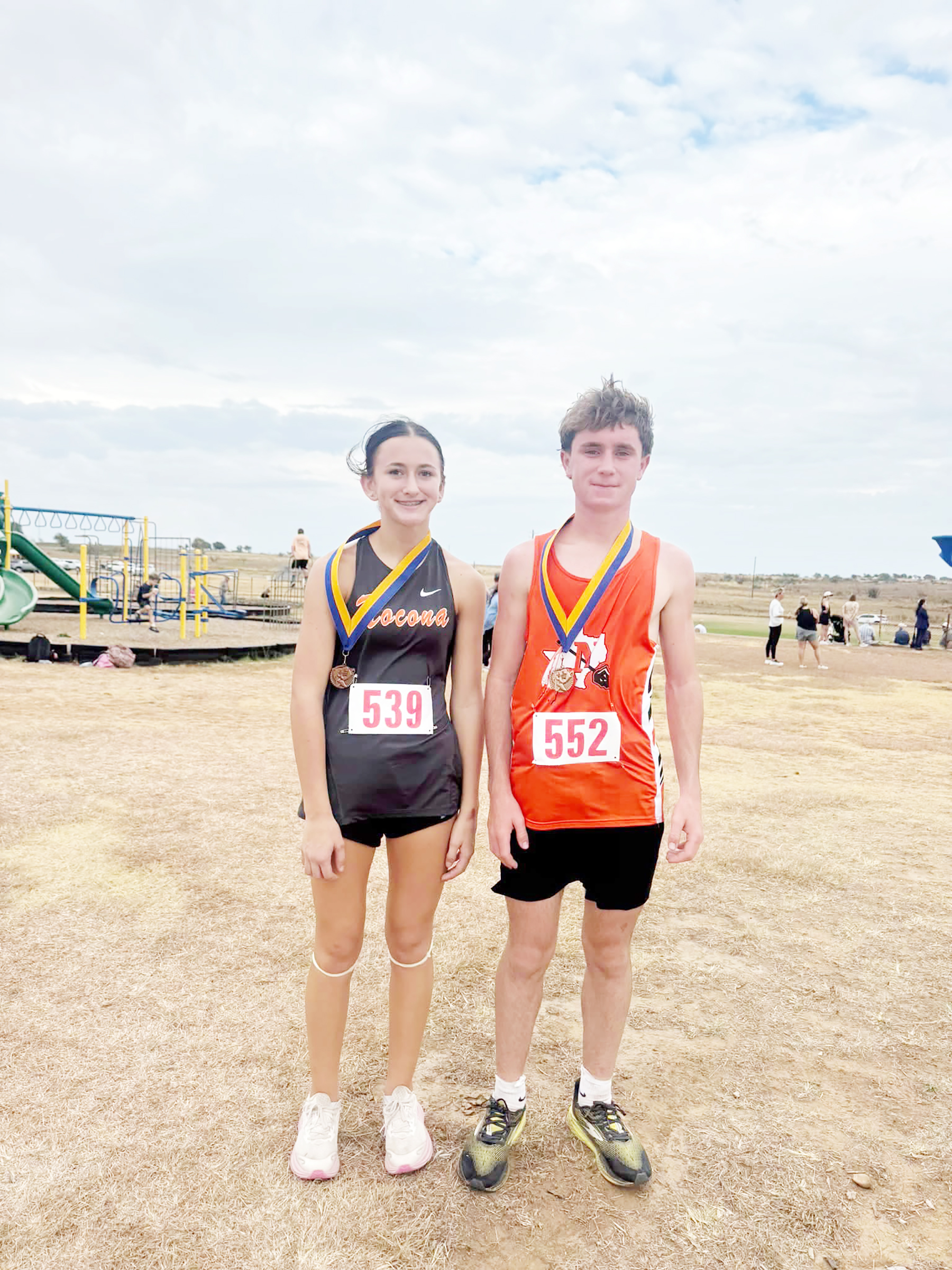
Nocona and Prairie Valley cross country teams took part in the Prairie Valley Invitational Sept. 20 while Bowie varsity runners competed in the Lubbock Invitational.
Lubbock
Leading the Rabbits was Kellen Rater who finished 10th among 162 runners with a time of 17:24.50. Finishing behind Rater was Shawn Willett with a time of 19:33.20. Hayden Sutton ran a 20:27.10 followed by Taven Melton in 20:39.20, Coleman Holloway in 20:53.80 and Jaxon Castro with a time of 21:31.60.
Laney Segura led the Lady Rabbits with a time of 14:41.30. She was followed by Kylee Waldrep in 15:56.80, Bella Lozano in 16:04.80, Angeles Alvarez with a time of 16:15.40, AnDee Miller in 16:23.70 and Isabella Caswell in 16:51 flat.
For further details, pick up a copy of Thursday’s Bowie News.






-

 NEWS3 years ago
Suspect indicted, jailed in Tia Hutson murder
-
 NEWS4 years ago
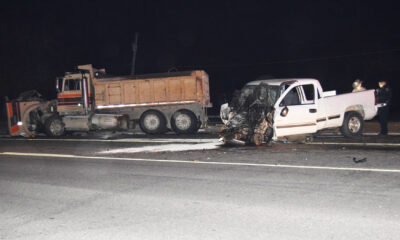
Wreck takes the life of BHS teen, 16
-
 NEWS4 years ago
2 hurt, 1 jailed after shooting incident north of Nocona
-

 NEWS3 years ago
Murder unsolved – 1 year later Tia Hutson’s family angry, frustrated with no arrest
-
 NEWS3 years ago
SO investigating possible murder/suicide
-
 Show us something good9 years ago
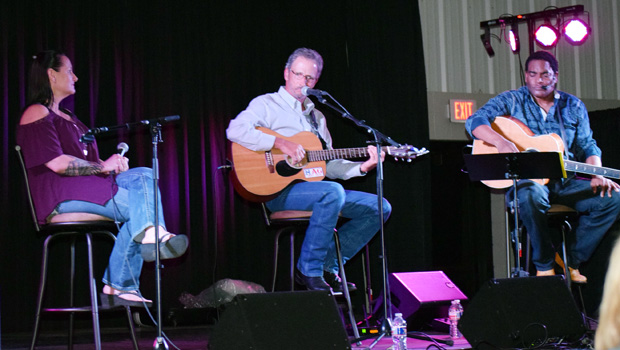
Country music star children perform in Bowie
-
 100th Birthday4 years ago
Looking back at the 1958 Centennial edition of The Bowie News
-
NEWS3 years ago
Sheriff’s office called out to infant’s death